
Đề thi thử Tiếng Anh THPT 2026 – THPT Chuyên Tuyên Quang là đề ôn tập môn Tiếng Anh dành cho học sinh lớp 12, bám sát nội dung SGK Cánh Diều. Đề thi do ThS. Vũ Khắc Ngọc – giáo viên Tiếng Anh trường ĐH Khoa học Tự nhiên, Hà Nội biên soạn năm 2026, với cấu trúc câu hỏi đa dạng từ nhận biết đến vận dụng cao, giúp các em học sinh làm quen với các dạng bài trong kỳ Thi thử THPT Quốc Gia. Bài kiểm tra này được cung cấp độc quyền trên nền tảng detracnghiem.edu.vn.
Với bộ thi thử Tiếng Anh THPT này, các em sẽ tìm thấy các câu hỏi được xây dựng kỹ lưỡng, bám sát chương trình và có lời giải thích rõ ràng, chi tiết, giúp học sinh lớp 12 dễ dàng ôn tập và củng cố kiến thức. Hãy truy cập detracnghiem.edu.vn ngay hôm nay để trải nghiệm và nâng cao năng lực, tự tin bước vào kỳ thi sắp tới.
Đề thi thử Tiếng Anh THPT 2026 – THPT Chuyên Tuyên Quang
LINK PDF ĐỀ THI [gồm ĐỀ THI, ĐÁP ÁN, LỜI GIẢI]:
TRƯỜNG THPT CHUYÊN
TƯƠNG QUANG
ĐỀ THI KHẢO SÁT CHẤT LƯỢNG THPT 2026
MÔN: TIẾNG ANH
Thời gian làm bài: 50 phút, không kể thời gian giao đề
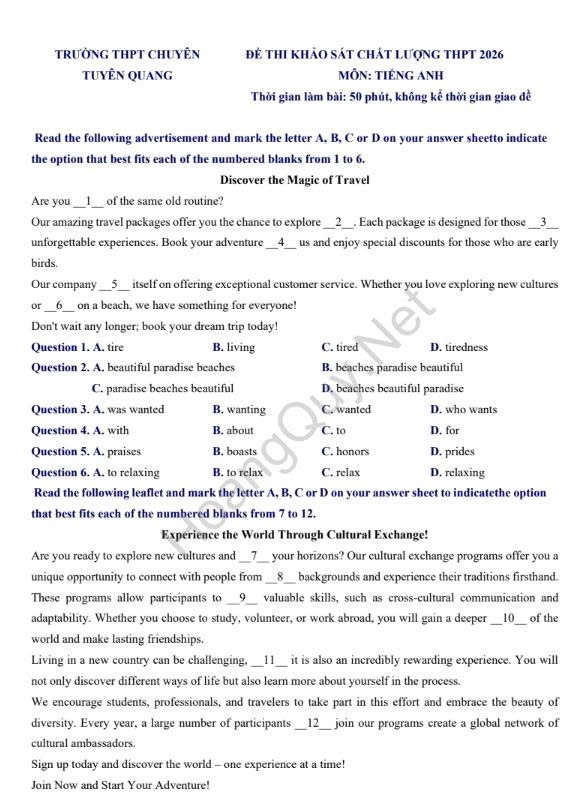
Read the following advertisement and mark the letter A, B, C or D on your answer sheetto indicate
the option that best fits each of the numbered blanks from 1 to 6.
Discover the Magic of Travel
Are you ___1___ of the same old routine?
Our amazing travel packages offer you the chance to explore ___2___. Each package is designed for those ___3___
unforgettable experiences. Book your adventure ___4___ us and enjoy special discounts for those who are early
birds.
Our company ___5___ itself on offering exceptional customer service. Whether you love exploring new cultures
or ___6___ on a beach, we have something for everyone!
Don’t wait any longer; book your dream trip today!
Question 1. A. tire
B. living
C. tired
D. tiredness
Question 2. A. beautiful paradise beaches
B. beaches paradise beautiful
C. paradise beaches beautiful
D. beaches beautiful paradise
Question 3. A. was wanted
B. wanting
C. wanted
D. who wants
Question 4. A. with
B. about
C. to
D. for
Question 5. A. praises
B. boasts
C. honors
D. prides
Question 6. A. to relax
B. to relaxing
C. relax
D. relaxing
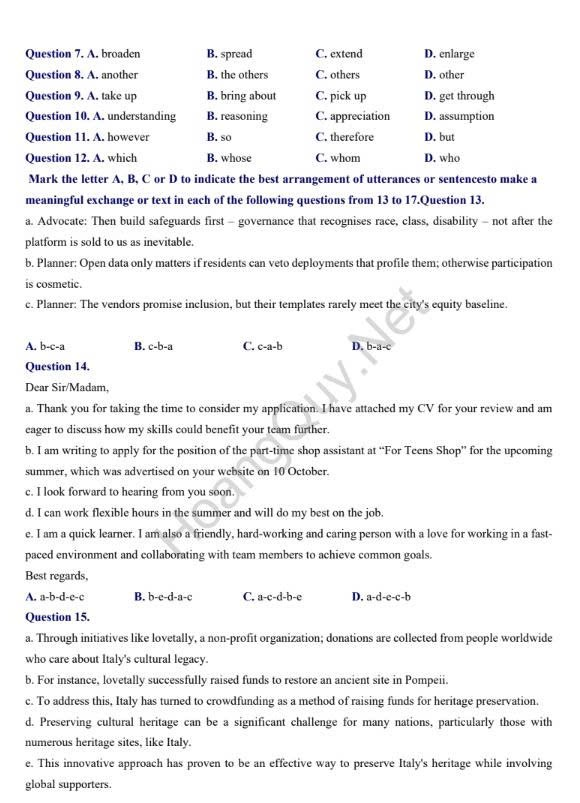
Read the following leaflet and mark the letter A, B, C or D on your answer sheet to indicatethe option
that best fits each of the numbered blanks from 7 to 12.
Experience the World Through Cultural Exchange!
Are you ready to explore new cultures and ___7___ your horizons? Our cultural exchange programs offer you a
unique opportunity to connect with people from ___8___ backgrounds and experience their traditions firsthand.
These programs allow participants to ___9___ valuable skills, such as cross-cultural communication and
adaptability. Whether you choose to study, volunteer, or work abroad, you will gain a deeper ___10___ of the
world and make lasting friendships.
Living in a new country can be challenging, ___11___ it is also an incredibly rewarding experience. You will
not only discover different ways of life but also learn more about yourself in the process. We encourage students,
professionals, and travelers to take part in this effort and embrace the beauty of diversity. Every year, a large
number of participants ___12___ join our programs create a global network of cultural ambassadors.
Sign up today and discover the world – one experience at a time!
Join Now and Start Your Adventure!
Question 7. A. broaden
B. spread
C. extend
D. enlarge
Question 8. A. another
B. the others
C. others
D. other
Question 9. A. take up
B. bring about
C. pick up
D. get through
Question 10. A. understanding
B. reasoning
C. appreciation
D. assumption
Question 11. A. however
B. so
C. therefore
D. but
Question 12. A. which
B. whose
C. whom
D. who
Mark the letter A, B, C or D to indicate the best arrangement of utterances or sentencesto make a
meaningful exchange or text in each of the following questions from 13 to 17.Question 13.
a. Advocate: Then build safeguards first – governance that recognises race, class, disability – not after the
platform is sold to us as inevitable.
b. Planner: Open data only matters if residents can veto deployments that profile them; otherwise participation
is cosmetic.
c. Planner: The vendors promise inclusion, but their templates rarely meet the city’s equity baseline.
A. b-c-a
B. c-b-a
C. c-a-b
D. b-a-c
Question 14.
Dear Sir/Madam,
a. Thank you for taking the time to consider my application. I have attached my CV for your review and am
eager to discuss how my skills could benefit your team further.
b. I am writing to apply for the position of the part-time shop assistant at “For Teens Shop” for the upcoming
summer, which was advertised on your website on 10 October.
c. I look forward to hearing from you soon.
d. I can work flexible hours in the summer and will do my best on the job.
e. I am a quick learner. I am also a friendly, hard-working and caring person with a love for working in a fast-
paced environment and collaborating with team members to achieve common goals.
Best regards,
A. a-b-d-c-c
B. b-e-d-a-c
C. a-c-d-b-e
D. d-a-c-c-b
Question 15.
a. Through initiatives like lovettally, a non-profit organization; donations are collected from people worldwide
who care about Italy’s cultural legacy.
b. For instance, lovettally successfully raised funds to restore an ancient site in Pompeii.
c. To address this, Italy has turned to crowdfunding as a method for raising funds for heritage preservation.
d. Preserving cultural heritage can be a significant challenge for many nations, particularly those with
numerous heritage sites, like Italy.
e. This innovative approach has proven to be an effective way to preserve Italy’s heritage while involving
global supporters.
A. d-e-c-a-b
B. d-c-a-b-e
C. d-b-c-a-e
D. d-b-e-a-c
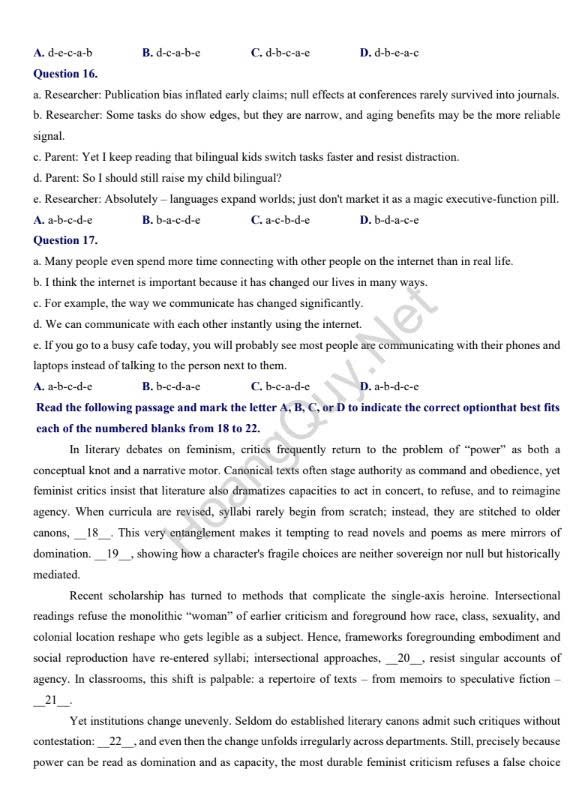
Question 16.
a. Researcher: Publication bias inflated early claims; null effects at conferences rarely survived into journals.
b. Researcher: Some tasks do show edges, but they are narrow, and aging benefits may be the more reliable
signal.
c. Parent: Yet I keep reading that bilingual kids switch tasks faster and resist distraction.
d. Parent: So I should still raise my child bilingual?
e. Researcher: Absolutely – languages expand worlds; just don’t market it as a magic executive-function pill.
A. a-b-c-d-e
B. b-a-c-d-e
C. a-c-b-d-e
D. d-b-d-a-e-c
Question 17.
a. Many people even spend more time connecting with other people on the internet than in real life.
b. I think the internet is important because it has changed our lives in many ways.
c. For example, the way we communicate has changed significantly.
d. We can communicate with each other instantly using the internet.
e. If you go to a busy cafe today, you will probably see most people are communicating with their phones
and laptops instead of talking to the person next to them.
A. a-b-c-d-e
B. b-c-d-a-e
C. b-c-a-d-e
D. a-b-d-e-c
Read the following passage and mark the letter A, B, C or D to indicate the correct optionthat best fits
each of the numbered blanks from 18 to 22.
In literary debates on feminism, critics frequently return to the problem of “power” as both a
conceptual knot and a narrative motor. Canonical texts often stage authority as command and obedience, yet
feminist critics insist that literature also dramatizes capacities to act in concert, to refuse, and to reimagine
agency. When curricula are revised, syllabi rarely begin from scratch; instead, they are stitched to older
canons, ___18___. This very entanglement makes it tempting to read novels and poems as mere mirrors of
domination, ___19___, showing how a character’s fragile choices are neither sovereign nor null but historically
mediated.
Recent scholarship has turned to methods that complicate the single-axis heroine. Intersectional
readings refuse the monolithic “woman” of earlier criticism and foreground how race, class, sexuality, and
colonial location reshape who gets legible as a subject. Hence, frameworks foregrounding embodiment and
social reproduction have re-entered syllabi; intersectional approaches, ___20___, resist singular accounts of
agency. In classrooms, this shift is palpable: a repertoire of texts – from memoirs to speculative fiction –
___21___.
Yet institutions change unevenly. Seldom do established literary canons admit such critiques without
contestation; ___22___ and even then the change unfolds irregularly across departments. Still, precisely because
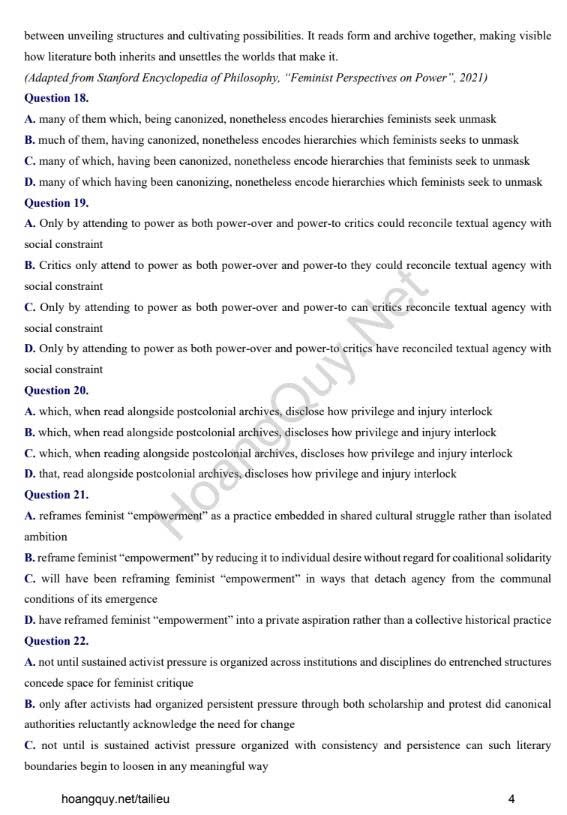
power can be read as domination and as capacity, the most durable feminist criticism refuses a false choice
between unveiling structures and cultivating possibilities. It reads form and archive together, making visible
how literature both inherits and unsettles the worlds that make it.
(Adapted from Stanford Encyclopedia of Philosophy, “Feminist Perspectives on Power”, 2021)
Question 18. A. many of them which, being canonized, nonetheless encodes hierarchies feminist critics seek unmask
B. much of them, having canonized, nonetheless encodes hierarchies which feminists seeks to unmask
C. many of which, having been canonized, nonetheless encode hierarchies that feminist seek to unmask
D. many of which having been canonizing, nonetheless encode hierarchies which feminists seek to unmask
Question 19. A. Only by attending to power as both power-over and power-to critics could reconcile textual agency with
social constraint
B. Critics only attend to power as both power-over and power-to they could reconcile textual agency with
social constraint
C. Only by attending to power as both power-over and power-to can critics reconcile textual agency with
social constraint
D. Only by attending to power as both power-over and power-to critics have reconciled textual agency with
social constraint
Question 20. A. which, when read alongside postcolonial archives, disclose how privilege and injury interlock
B. which, when read alongside postcolonial archives, discloses how privilege and injury interlock
C. when, which read alongside postcolonial archives, discloses how privilege and injury interlock
D. that, read alongside postcolonial archives, discloses how privilege and injury interlock
Question 21. A. reframes feminist “empowerment” as a practice embedded in shared cultural struggle rather than isolated
ambition
B. reframe feminist “empowerment” by reducing it to individual desire without regard for coalitional solidarity
C. will have been reframing feminist “empowerment” in ways that detach agency from the communal
conditions of its emergence
D. have reframed feminist “empowerment” into a private aspiration rather than a collective historical practice
Question 22. A. not until sustained activist pressure is organized across institutions and disciplines do entrenched structures
concede space for feminist critique
B. only after activists had organized persistent pressure through both scholarship and protest did canonical
authorities reluctantly acknowledge the need for change
C. not until is sustained activist pressure organized with consistency and persistence can such literary
boundaries begin to loosen in any meaningful way
D. until sustained activist pressure was organized not coherently across the academy, few reforms could be
said to alter the canon in practice
Read the following passage and mark the letter A, B, C or D to indicate the correct answerto each of
the questions from 23 to 30.
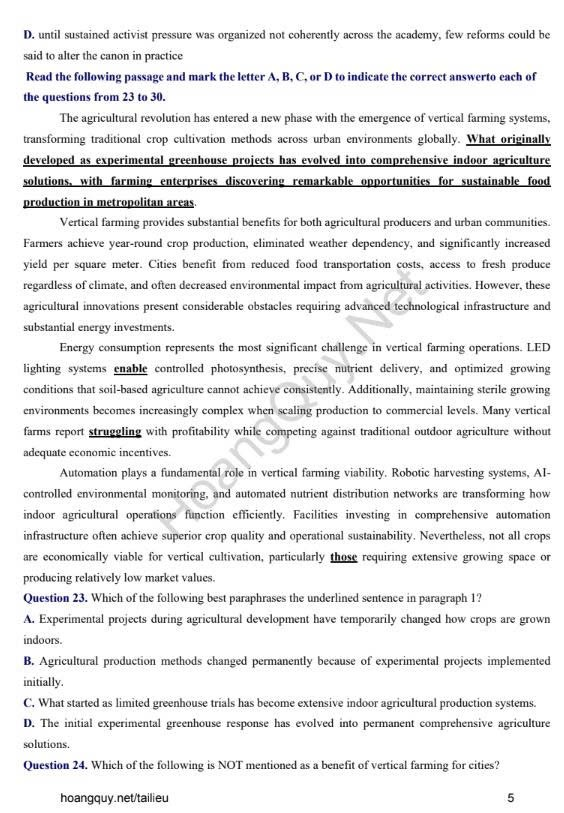
The agricultural revolution has entered a new phase with the emergence of vertical farming systems,
transforming traditional crop cultivation methods across urban environments globally. What originally
developed as experimental greenhouse projects has evolved into comprehensive indoor agriculture
solutions, with farming enterprises discovering remarkable opportunities for sustainable food
production in metropolitan areas.
Vertical farming provides substantial benefits for both agricultural producers and urban communities.
Farmers achieve year-round crop production, eliminated weather dependency, and significantly increased
yield per square meter. Cities benefit from reduced food transportation costs, access to fresh produce
regardless of climate, and often decreased environmental impact from agricultural activities. However, these
agricultural innovations present considerable obstacles requiring advanced technological infrastructure and
substantial energy investments.
Energy consumption represents the most significant challenge in vertical farming operations. LED
lighting systems enable controlled photosynthesis, precise nutrient delivery, and optimized growing
conditions that soil-based agriculture cannot achieve consistently. Additionally, maintaining sterile growing
environments becomes increasingly complex when scaling production to commercial levels. Many vertical
farms report struggling with profitability while competing against traditional outdoor agriculture without
adequate economic incentives.
Automation plays a fundamental role in vertical farming viability. Robotic harvesting systems, AI-
controlled environmental monitoring, and automated nutrient distribution networks are transforming how
indoor agricultural operations’ function efficiently. Facilities investing in comprehensive automation
infrastructure often achieve superior crop quality and operational sustainability. Nevertheless, not all crops
are economically viable for vertical cultivation, particularly those requiring extensive growing space or
producing relatively low market values.
Question 23. Which of the following best paraphrases the underlined sentence in paragraph 1?
A. Experimental projects during agricultural development have temporarily changed how crops are grown
indoors.
B. Agricultural production methods changed permanently because of experimental projects implemented
initially.
C. What started as limited greenhouse trials has become extensive indoor agricultural production systems.
D. The initial experimental greenhouse response has evolved into permanent comprehensive agriculture
solutions.
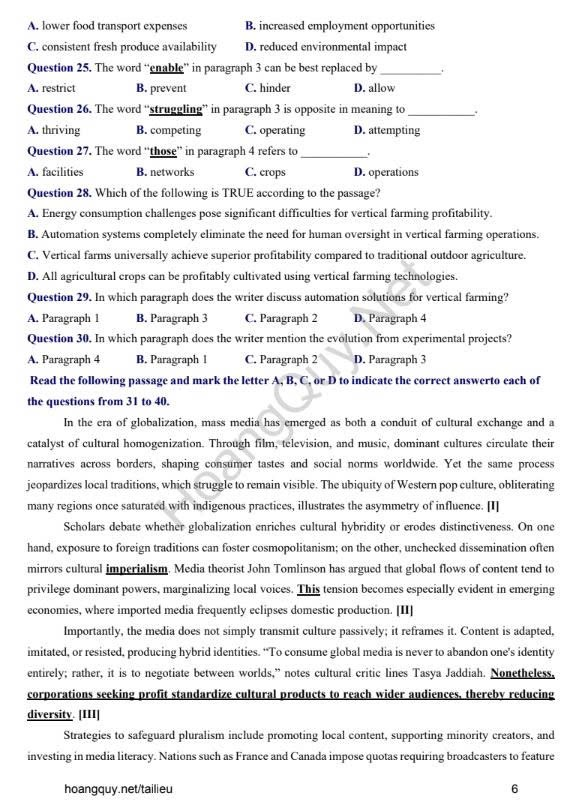
Question 24. Which of the following is NOT mentioned as a benefit of vertical farming for cities?
A. lower food transport expenses
B. increased employment opportunities
C. fresh produce availability
D. reduced environmental impact
Question 25. The word “enable” in paragraph 3 can be best replaced by
A. restrict
B. prevent
C. hinder
D. allow
Question 26. The word “struggling” in paragraph 3 is opposite in meaning to _____
A. thriving
B. competing
C. operating
D. attempting
Question 27. The word “those” in paragraph 4 refers to _____
A. facilities
B. networks
C. crops
D. operations
Question 28. Which of the following is TRUE according to the passage?
A. Energy consumption challenges pose significant difficulties for vertical farming profitability.
B. Automation systems completely eliminate the need for human oversight in vertical farming operations.
C. Vertical farms universally achieve superior profitability compared to traditional outdoor agriculture.
D. All agricultural crops can be profitably cultivated using vertical farming technologies.
Question 29. In which paragraph does the writer discuss automation solutions for vertical farming?
A. Paragraph 1
B. Paragraph 2
C. Paragraph 3
D. Paragraph 4
Question 30. In which paragraph does the writer mention the evolution from experimental projects?
A. Paragraph 4
B. Paragraph 1
C. Paragraph 2
D. Paragraph 3
Read the following passage and mark the letter A, B, C or D to indicate the correct answerto each of
the questions from 31 to 40.
In the era of globalization, mass media has emerged as both a conduit of cultural exchange and a
catalyst of cultural homogenization. Through film, television, and music, dominant cultures circulate their
narratives across borders, shaping consumer tastes and social norms worldwide. Yet the same process
jeopardizes local traditions, which struggle to remain visible. The ubiquity of Western pop culture,
obliterating many regions once saturated with indigenous practices, illustrates the asymmetry of influence.
[I]
Scholars debate whether globalization embraces cultural hybridity or erodes distinctiveness. On one
hand, exposure to foreign traditions can foster cosmopolitanism; on the other, unchecked dissemination often
mirrors cultural imperialism. Media theorist John Tomlinson has argued that global flows of content tend to
privilege dominant powers, marginalizing local voices. [II] This tension becomes especially evident in
emerging economies, where imported media frequently eclipses domestic production. [III]
Importantly, the media does not simply transmit culture passively; it reframes it. Content is adapted,
imitated, or resisted, producing hybrid identities. “To consume global media is never to abandon one’s
identity entirely; rather, it is to negotiate between worlds,” notes cultural critic lines Tasya Jaddiah.
Nonetheless, corporations seeking profit standardize cultural products to reach wider audiences, thereby
reducing diversity. [IIII]
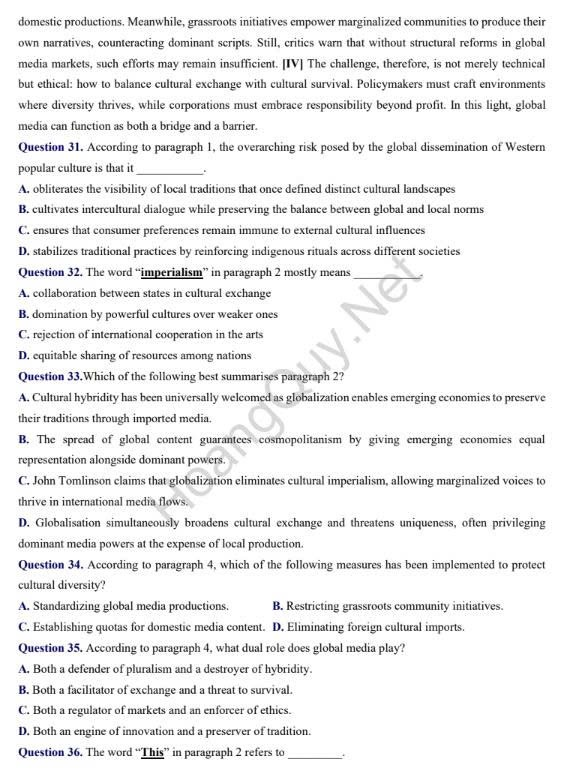
Strategies to safeguard pluralism include promoting local content, supporting minority creators, and
investing in media literacy. Nations such as France and Canada impose quotas requiring broadcasters to
feature domestic productions. Meanwhile, grassroots initiatives empower marginalized communities to
produce their own narratives, counteracting dominant scripts. Still, critics warn that without structural reforms
in global media markets, such efforts may remain insufficient. [IV] The challenge, therefore, is not merely
technical but ethical: how to balance cultural exchange with cultural survival. Policymakers must craft
environments where diversity thrives, while corporations must embrace responsibility beyond profit. In this
light, global media can function as both a bridge and a barrier.
Question 31. According to paragraph 1, the overarching risk posed by the global dissemination of Western
popular culture is that it _____
A. obliterates the visibility of local traditions that once defined distinct cultural landscapes
B. cultivates intercultural dialogue while preserving the balance between global and local norms
C. ensures that consumer preferences remain immune to external cultural influences
D. stabilizes traditional practices by reinforcing indigenous rituals across different societies
Question 32. The word “imperialism” in paragraph 2 mostly means _____
A. collaboration between states in cultural exchange
B. domination by powerful cultures over weaker ones
C. rejection of international cooperation in the arts
D. equitable sharing of resources among nations
Question 33. Which of the following best summarises paragraph 2?
A. Cultural hybridity has been universally welcomed as globalization enables emerging economies to preserve
their traditions through imported media.
B. The spread of global content guarantees cosmopolitanism by giving emerging economies equal
representation alongside dominant powers.
C. John Tomlinson claims that globalization eliminates cultural imperialism, allowing marginalized voices to
thrive in international media flows.
D. Globalisation simultaneously broadens cultural exchange and threatens uniqueness, often privileging
dominant media powers at the expense of local production.
Question 34. According to paragraph 4, which of the following measures has been implemented to protect
cultural diversity?
A. Standardizing global media productions.
B. Restricting grassroots community initiatives.
C. Establishing quotas for domestic media content.
D. Eliminating foreign cultural imports.
Question 35. According to paragraph 4, what dual role does global media play?
A. Both a defender of pluralism and a destroyer of hybridity.
B. Both a facilitator of exchange and a threat to survival.
C. Both a regulator of markets and an enforcer of ethics.
D. Both an engine of innovation and a preserver of tradition.
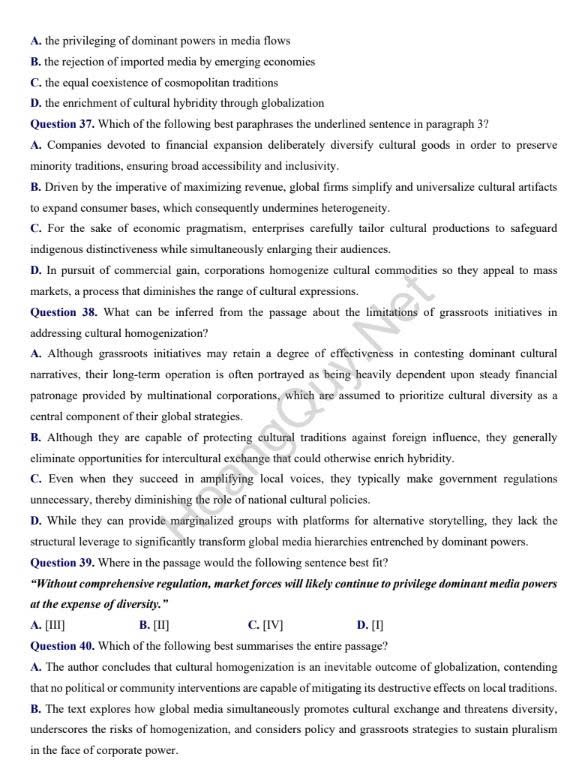
Question 36. The word “This” in paragraph 2 refers to _____
A. the privileging of dominant powers in media flows
B. the rejection of imported media by emerging economies
C. the equal coexistence of cosmopolitan traditions
D. the enrichment of cultural hybridity through globalization
Question 37. Which of the following best paraphrases the underlined sentence in paragraph 3?
A. Companies prioritizing profit often streamline their cultural offerings to appeal to a larger market, which
in turn diminishes variety.
B. Corporations often reduce their profits by diversifying cultural products to cater to a broader range of
consumer preferences.
C. Despite their efforts, companies find it challenging to standardize cultural products without losing diverse
audiences.
D. Cultural diversity is unintentionally promoted when corporations aim for wider audience engagement
through product standardization.
Question 38. What can be inferred from the passage about the limitations of grassroots initiatives in
addressing cultural homogenization?
A. Although grassroots initiatives may retain a degree of effectiveness in contesting dominant cultural
narratives, their long-term operation is often portrayed as being heavily dependent upon steady financial
patronage provided by multinational corporations, which are assumed to prioritize cultural diversity as a
central component of their global strategies.
B. Although they are capable of protecting cultural traditions against foreign influence, they generally
eliminate opportunities for intercultural exchange that could otherwise enrich hybridity.
C. Even when they succeed in amplifying local voices, they typically make government regulations
unnecessary, thereby diminishing the role of national cultural policies.
D. While they can provide marginalized groups with platforms for alternative storytelling, they lack the
structural leverage to significantly transform global media hierarchies entrenched by dominant powers.
Question 39. Where in the passage would the following sentence best fit?
(“Without comprehensive regulation, market forces will likely continue to privilege dominant media powers
at the expense of diversity.”)
A. [III]
B. [II]
C. [IV]
D. [I]
Question 40. Which of the following best summarises the entire passage?
A. The author concludes that cultural homogenization is an inevitable outcome of globalization, contending
that no political or community interventions are capable of mitigating its destructive effects on local traditions.
B. The text explores how global media simultaneously promotes cultural exchange and threatens diversity,
underscores the risks of homogenization, and considers policy and grassroots strategies to sustain
pluralism in the face of corporate power.
C. The passage primarily emphasizes the economic advantages of global media, arguing that market-driven
standardization is an efficient way to disseminate cultural products worldwide, thereby promoting universal
understanding.
D. The author challenges the notion of cultural imperialism, asserting that media consumers actively resist
dominant narratives and create unique hybrid identities, making external interventions unnecessary.