
Đề thi thử Tiếng Anh THPT 2026 – SỞ GIÁO DỤC & ĐÀO TẠO là đề ôn tập môn Tiếng Anh dành cho học sinh lớp 12, bám sát nội dung SGK Bộ giáo dục. Đề thi do Giáo viên – giáo viên trường SỞ GIÁO DỤC & ĐÀO TẠO biên soạn năm 2026, bao gồm các câu hỏi từ mức độ nhận biết đến vận dụng cao, giúp các em củng cố kiến thức toàn diện cho kỳ Thi thử THPT Quốc Gia. Bài thi này được cung cấp độc quyền trên nền tảng detracnghiem.edu.vn.
Để tối ưu hóa quá trình ôn luyện thi thử Tiếng Anh THPT, bài thi này được xây dựng với các câu hỏi kỹ lưỡng, đi kèm giải thích rõ ràng và đáp án chi tiết. Đây là tài liệu quý giá giúp học sinh lớp 12 chuẩn bị tốt nhất. Hãy truy cập detracnghiem.edu.vn ngay hôm nay để trải nghiệm và nâng cao năng lực, tự tin bước vào kỳ thi.
Đề thi thử Tiếng Anh THPT 2026 – SỞ GIÁO DỤC & ĐÀO TẠO
LINK PDF ĐỀ THI [gồm ĐỀ THI, ĐÁP ÁN, LỜI GIẢI]:
Questions 1-6
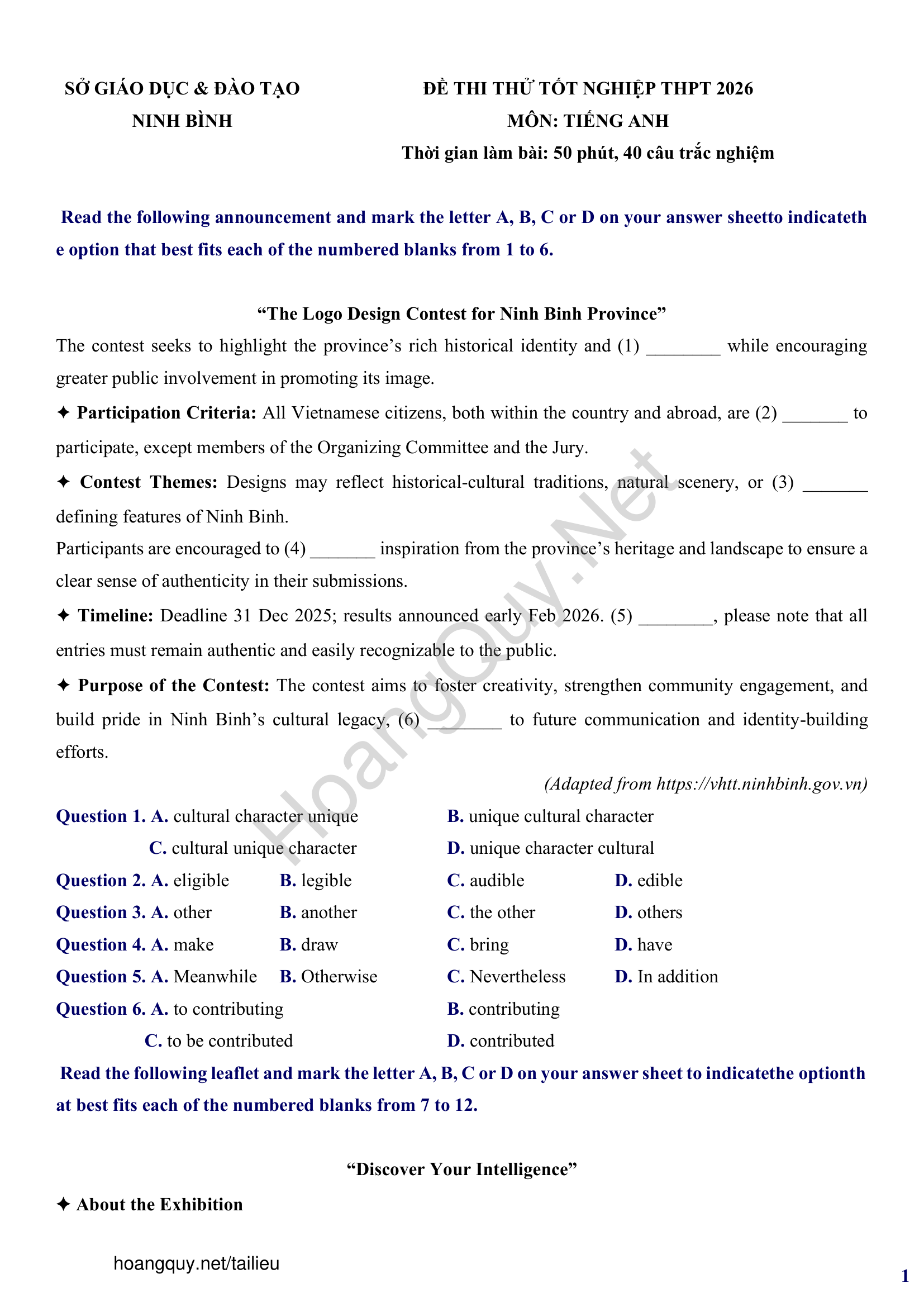
The Logo Design Contest for Ninh Binh Province
The contest seeks to highlight the province’s rich historical identity and (1) ________ while encouraging greater public involvement in promoting its image.
✦ Participation Criteria: All Vietnamese citizens, both within the country and abroad, are (2) ________ to participate, except members of the Organizing Committee and the Jury.
✦ Contest Themes: Designs may reflect historical-cultural traditions, natural scenery, or (3) ________ defining features of Ninh Binh.
Participants are encouraged to (4) ________ inspiration from the province’s heritage and landscape to ensure a clear sense of authenticity in their submissions.
✦ Timeline: Deadline 31 Dec 2025; results announced early Feb 2026. (5) ________, please note that all entries must remain authentic and easily recognizable to the public.
✦ Purpose of the Contest: The contest aims to foster creativity, strengthen community engagement, and build pride in Ninh Binh’s cultural legacy, (6) ________ to future communication and identity-building efforts.
(Adapted from https://vhtt.ninhbinh.gov.vn)
Câu 1:
A. cultural character unique
B. unique cultural character
C. cultural unique character
D. unique character cultural
Câu 2:
A. eligible
B. legible
C. audible
D. edible
Câu 3:
A. other
B. another
C. the other
D. others
Câu 4:
A. make
B. draw
C. bring
D. have
Câu 5:
A. Meanwhile
B. Otherwise
C. Nevertheless
D. In addition
Câu 6:
A. to contributing
B. contributing
C. to be contributed
D. contributed
Questions 7-12
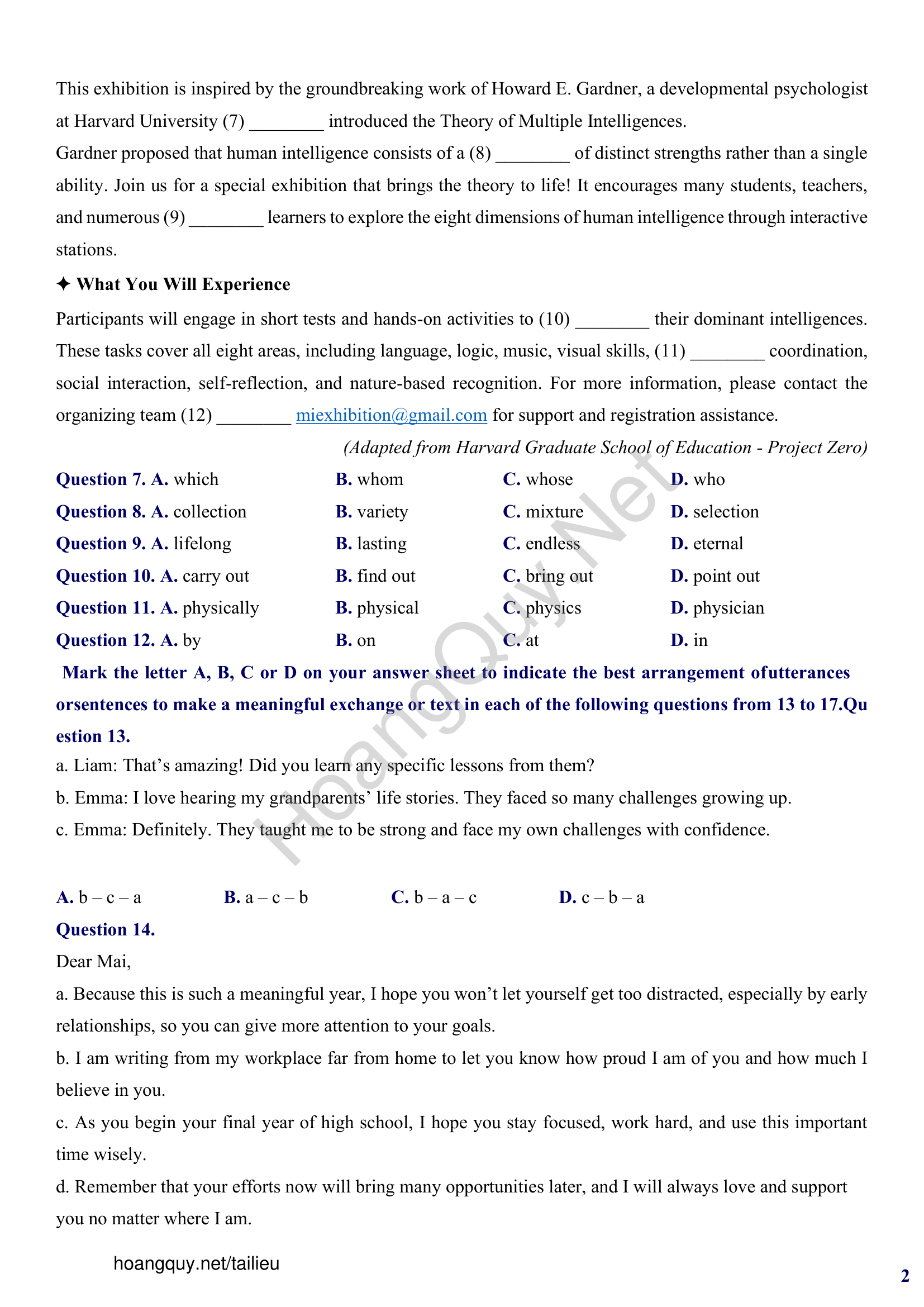
Discover Your Intelligence
✦ About the Exhibition
This exhibition is inspired by the groundbreaking work of Howard E. Gardner, a developmental psychologist at Harvard University (7) ________ introduced the Theory of Multiple Intelligences.
Gardner proposed that human intelligence consists of a (8) ________ of distinct strengths rather than a single ability. Join us for a special exhibition that brings the theory to life! It encourages many students, teachers, and numerous (9) ________ learners to explore the eight dimensions of human intelligence through interactive stations.
✦ What You Will Experience
Participants will engage in short tests and hands-on activities to (10) ________ their dominant intelligences. These tasks cover all eight areas, including language, logic, music, visual skills, (11) ________ coordination, social interaction, self-reflection, and nature-based recognition. For more information, please contact the organizing team (12) ________ miexhibition@gmail.com for support and registration assistance.
(Adapted from Harvard Graduate School of Education – Project Zero)
Câu 7:
A. which
B. whom
C. whose
D. who
Câu 8:
A. collection
B. variety
C. mixture
D. selection
Câu 9:
A. lifelong
B. lasting
C. endless
D. eternal
Câu 10:
A. carry out
B. find out
C. bring out
D. point out
Câu 11:
A. physically
B. physical
C. physics
D. physician
Câu 12:
A. by
B. on
C. at
D. in
Questions 13-17
Câu 13: Mark the letter A, B, C or D on your answer sheet to indicate the best arrangement of utterances or sentences to make a meaningful exchange or text in each of the following questions from 13 to 17.
a. Liam: That’s amazing! Did you learn any specific lessons from them?
b. Emma: I love hearing my grandparents’ life stories. They faced so many challenges growing up.
c. Emma: Definitely. They taught me to be strong and face my own challenges with confidence.
A. b – c – a
B. a – c – b
C. b – a – c
D. c – b – a
Câu 14: Dear Mai,
a. Because this is such a meaningful year, I hope you won’t let yourself get too distracted, especially by early relationships, so you can give more attention to your goals.
b. I am writing from my workplace far from home to let you know how proud I am of you and how much I believe in you.
c. As you begin your final year of high school, I hope you stay focused, work hard, and use this important time wisely.
d. Remember that your efforts now will bring many opportunities later, and I will always love and support you no matter where I am.
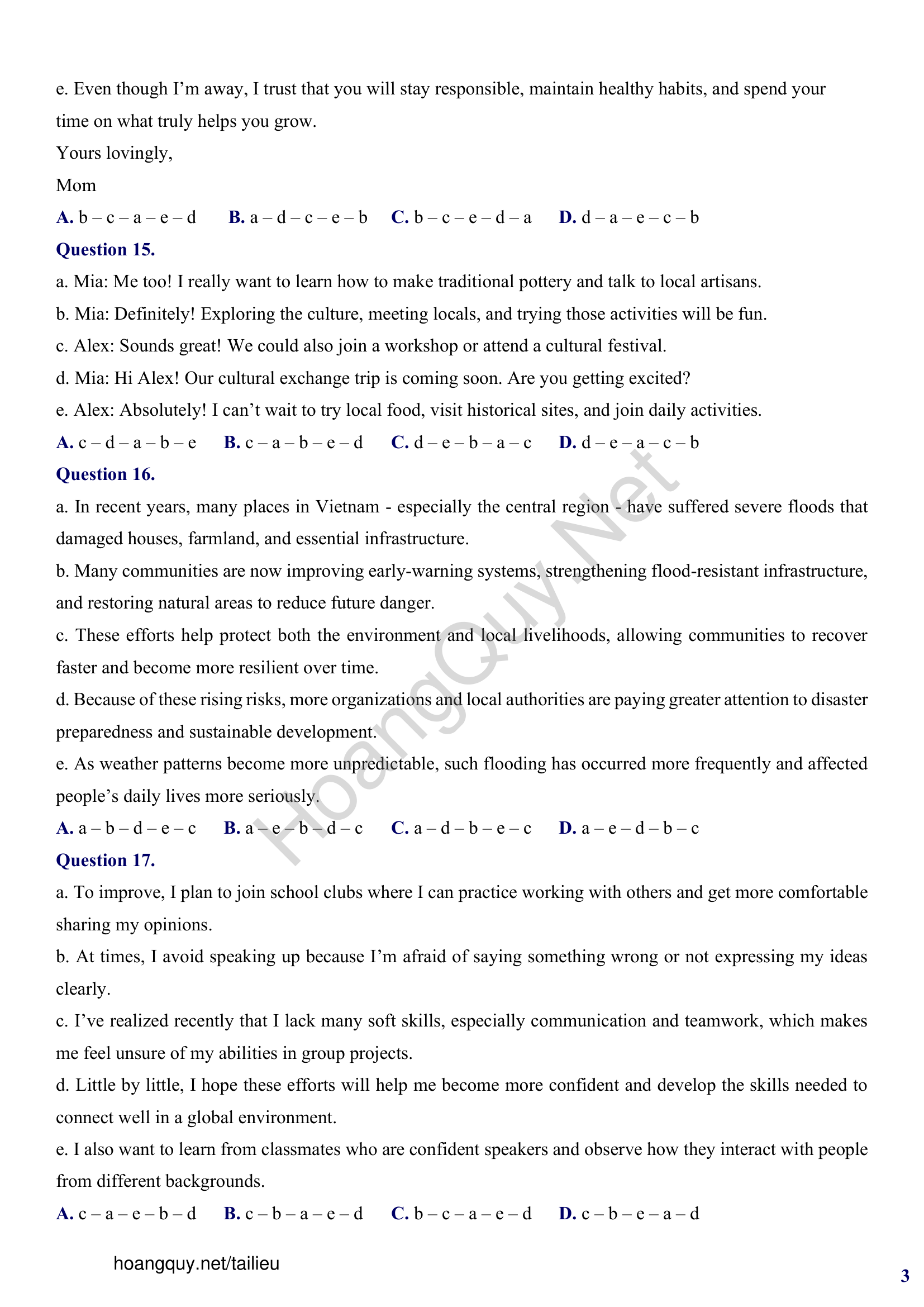
e. Even though I’m away, I trust that you will stay responsible, maintain healthy habits, and spend your time on what truly helps you grow.
Yours lovingly,
Mom
A. b – c – a – e – d
B. a – d – c – e – b
C. b – c – e – d – a
D. d – a – e – c – b
Câu 15: a. Mia: Me too! I really want to learn how to make traditional pottery and talk to local artisans.
b. Mia: Definitely! Exploring the culture, meeting locals, and trying those activities will be fun.
c. Alex: Sounds great! We could also join a workshop or attend a cultural festival.
d. Mia: Hi Alex! Our cultural exchange trip is coming soon. Are you getting excited?
e. Alex: Absolutely! I can’t wait to try local food, visit historical sites, and join daily activities.
A. c – d – a – b – e
B. c – a – b – e – d
C. d – e – b – a – c
D. d – e – a – c – b
Câu 16: a. In recent years, many places in Vietnam – especially the central region – have suffered severe floods that damaged houses, farmland, and essential infrastructure.
b. Many communities are now improving early-warning systems, strengthening flood-resistant infrastructure, and restoring natural areas to reduce future danger.
c. These efforts help protect both the environment and local livelihoods, allowing communities to recover faster and become more resilient over time.
d. Because of these rising risks, more organizations and local authorities are paying greater attention to disaster preparedness and sustainable development.
e. As weather patterns become more unpredictable, such flooding has occurred more frequently and affected people’s daily lives more seriously.
A. a – b – d – e – c
B. a – e – b – d – c
C. a – d – b – e – c
D. a – e – d – b – c
Câu 17: a. To improve, I plan to join school clubs where I can practice working with others and get more comfortable sharing my opinions.
b. At times, I avoid speaking up because I’m afraid of saying something wrong or not expressing my ideas clearly.
c. I’ve realized recently that I lack many soft skills, especially communication and teamwork, which makes me feel unsure of my abilities in group projects.
d. Little by little, I hope these efforts will help me become more confident and develop the skills needed to connect well in a global environment.
e. I also want to learn from classmates who are confident speakers and observe how they interact with people from different backgrounds.
A. c – a – e – b – d
B. c – b – a – e – d
C. b – c – a – e – d
D. c – b – e – a – d
Questions 18-22
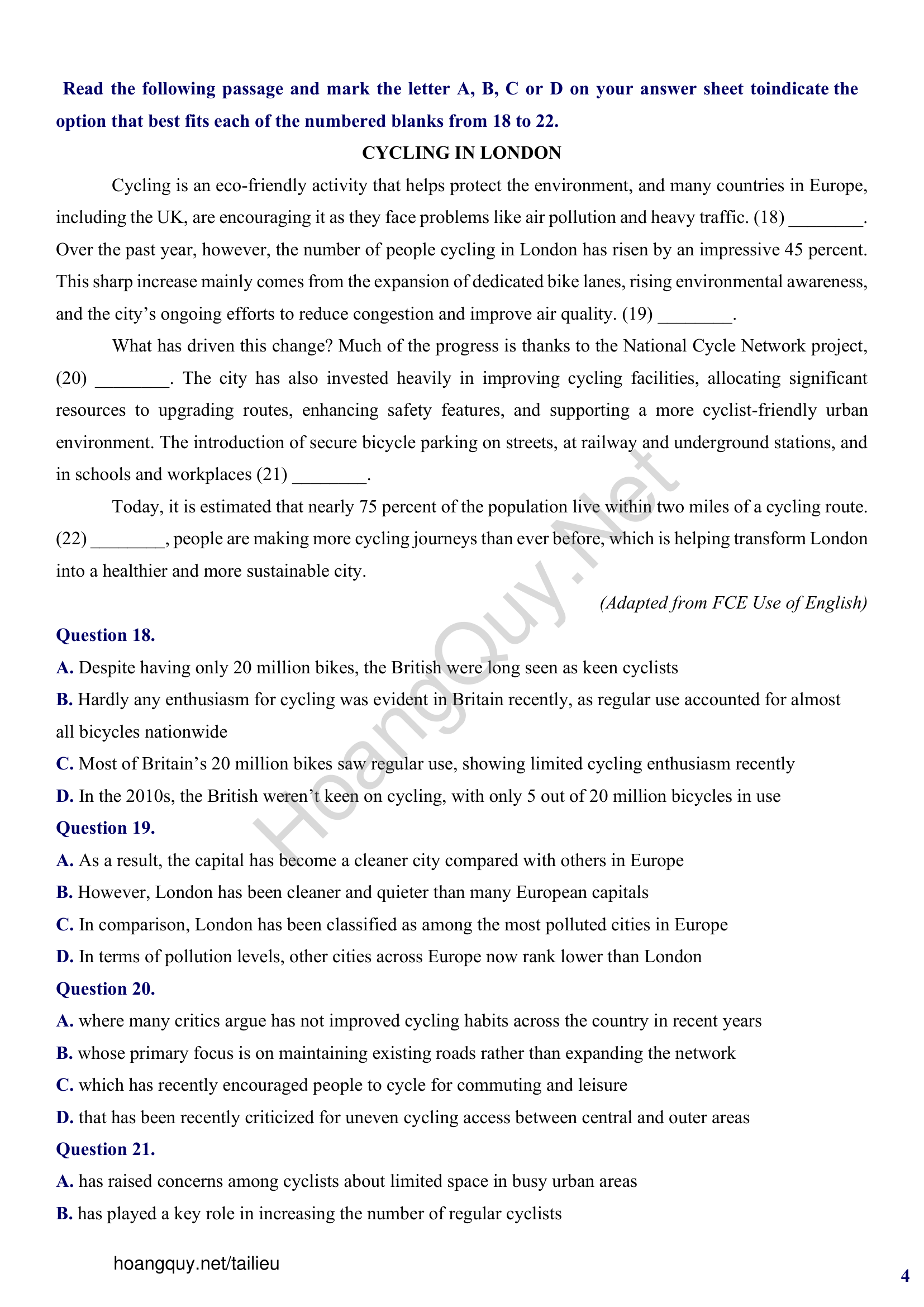
CYCLING IN LONDON
Cycling is an eco-friendly activity that helps protect the environment, and many countries in Europe, including the UK, are encouraging it as they face problems like air pollution and heavy traffic. (18) ________. Over the past year, however, the number of people cycling in London has risen by an impressive 45 percent. This sharp increase mainly comes from the expansion of dedicated bike lanes, rising environmental awareness, and the city’s ongoing efforts to reduce congestion and improve air quality. (19) ________.
What has driven this change? Much of the progress is thanks to the National Cycle Network project, (20) ________. The city has also invested heavily in improving cycling facilities, allocating significant resources to upgrading routes, enhancing safety features, and supporting a more cyclist-friendly urban environment. The introduction of secure bicycle parking on streets, at railway and underground stations, and in schools and workplaces (21) ________.
Today, it is estimated that nearly 75 percent of the population live within two miles of a cycling route. (22) ________, people are making more cycling journeys than ever before, which is helping transform London into a healthier and more sustainable city.
(Adapted from FCE Use of English)
Câu 18:
A. Despite having only 20 million bikes, the British were long seen as keen cyclists
B. Hardly any enthusiasm for cycling was evident in Britain recently, as regular use accounted for almost all bicycles nationwide
C. Most of Britain’s 20 million bikes saw regular use, showing limited cycling enthusiasm recently
D. In the 2010s, the British weren’t keen on cycling, with only 5 out of 20 million bicycles in use
Câu 19:
A. As a result, the capital has become a cleaner city compared with others in Europe
B. However, London has been cleaner and quieter than many European capitals
C. In comparison, London has been classified as among the most polluted cities in Europe
D. In terms of pollution levels, other cities across Europe now rank lower than London
Câu 20:
A. where many critics argue has not improved cycling habits across the country in recent years
B. whose primary focus is on maintaining existing roads rather than expanding the network
C. which has recently encouraged people to cycle for commuting and leisure
D. that has been recently criticized for uneven cycling access between central and outer areas
Câu 21:
A. has raised concerns among cyclists about limited space in busy urban areas
B. has played a key role in increasing the number of regular cyclists
C. has put people off cycling by making the parking process needlessly complicated
D. has introduced new guidelines for storing bicycles safely in public places
Câu 22:
A. While some areas continue to suffer from poor maintenance of cycling paths
B. In order to manage rising concerns about overcrowded cycling routes
C. Unless cycling infrastructure improves significantly in some areas
D. Because access has become more convenient with upgraded infrastructure
Questions 23-30
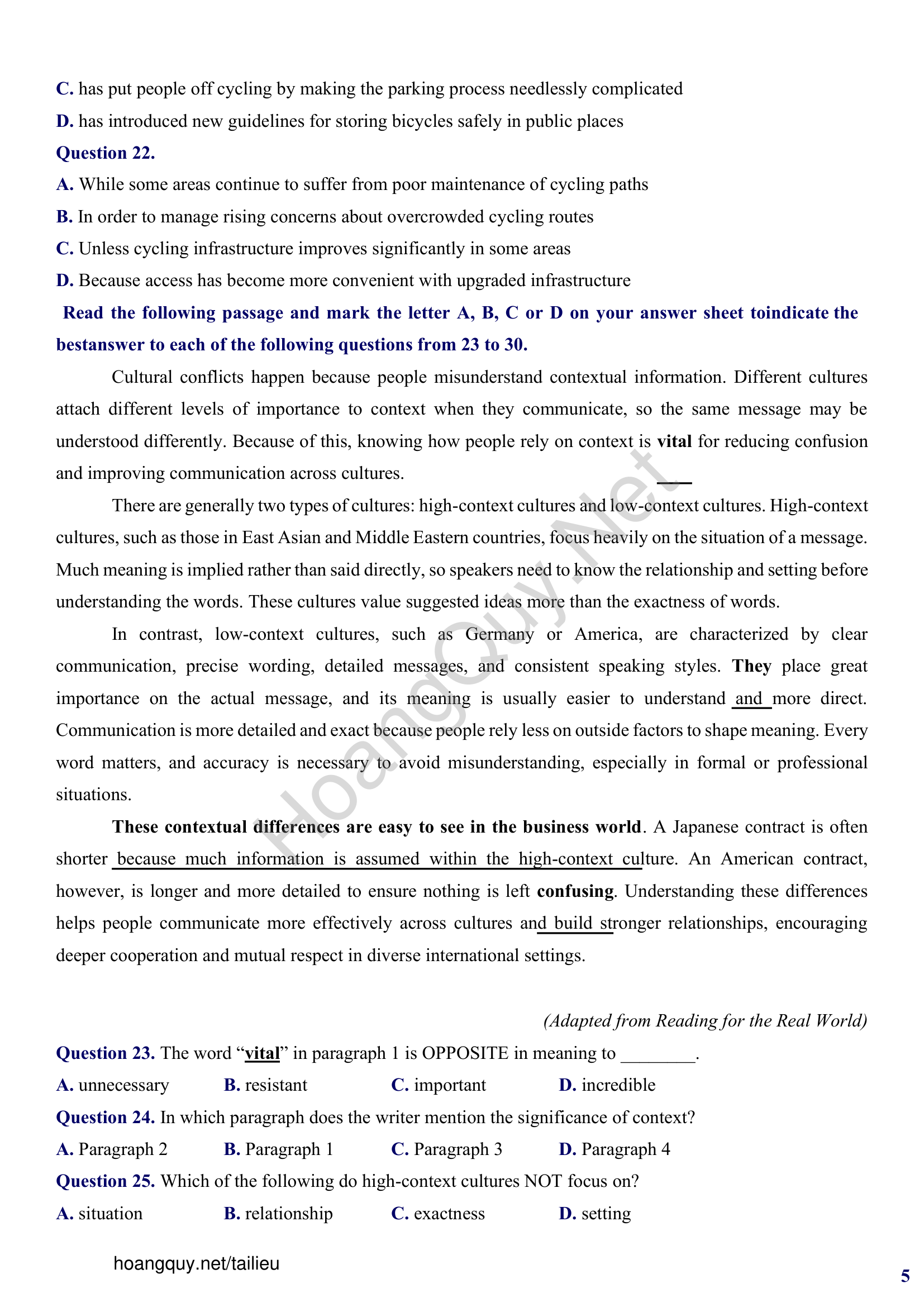
Cultural conflicts happen because people misunderstand contextual information. Different cultures attach different levels of importance to context when they communicate, so the same message may be understood differently. Because of this, knowing how people rely on context is vital for reducing confusion and improving communication across cultures.
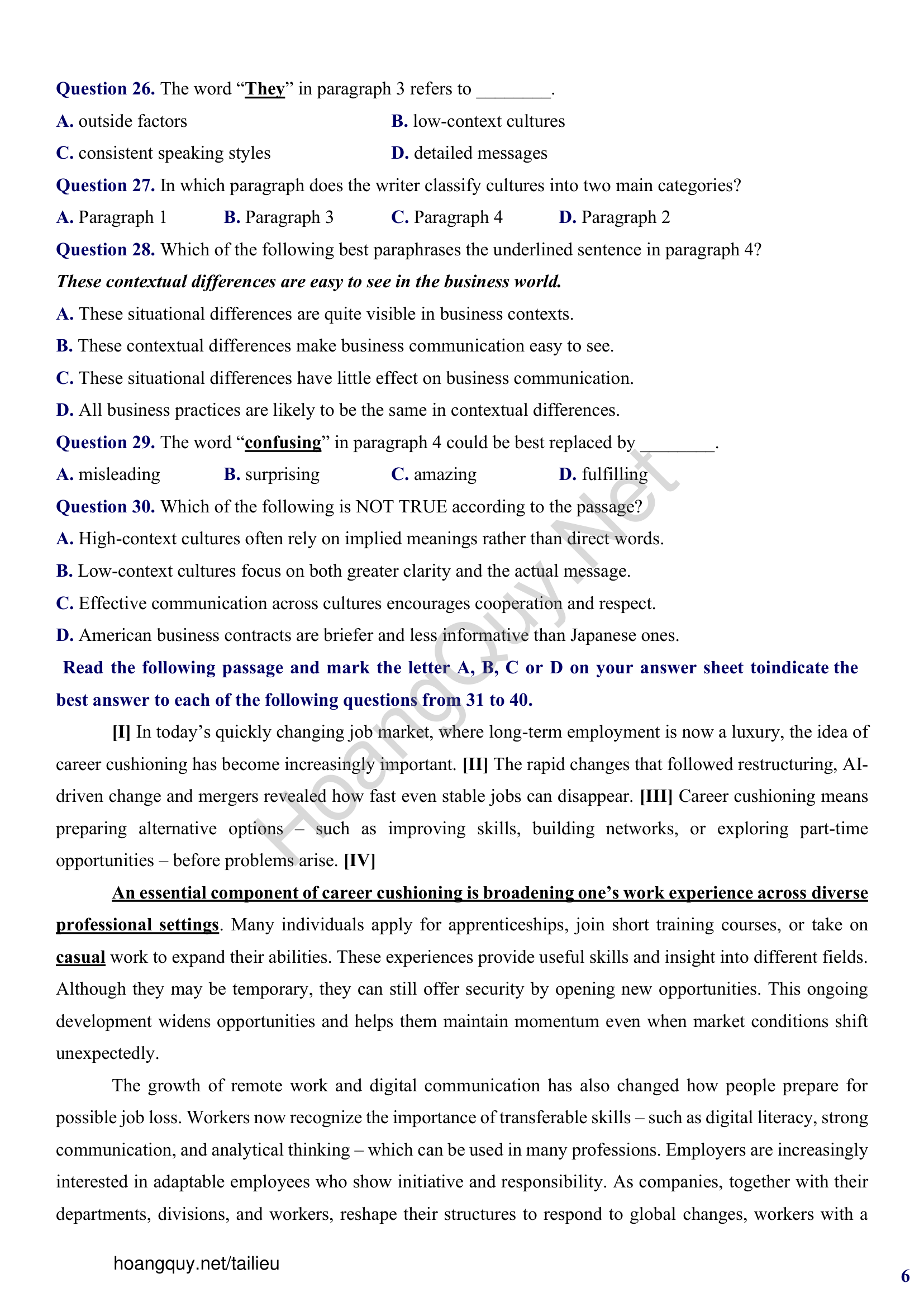
There are generally two types of cultures: high-context cultures and low-context cultures. High-context cultures, such as those in East Asian and Middle Eastern countries, focus heavily on the situation of a message. Much meaning is implied rather than said directly, so speakers need to know the relationship and setting before understanding the words. These cultures value suggested ideas more than the exactness of words.
In contrast, low-context cultures, such as Germany or America, are characterized by clear communication, precise wording, detailed messages, and consistent speaking styles. They place great importance on the actual message, and its meaning is usually easier to understand and more direct. Communication is more detailed and exact because people rely less on outside factors to shape meaning. Every word matters, and accuracy is necessary to avoid misunderstanding, especially in formal or professional situations.
These contextual differences are easy to see in the business world. A Japanese contract is often shorter because much information is assumed within the high-context culture. An American contract, however, is longer and more detailed to ensure nothing is left confusing. Understanding these differences helps people communicate more effectively across cultures and build stronger relationships, encouraging deeper cooperation and mutual respect in diverse international settings.
(Adapted from Reading for the Real World)
Câu 23:
Questions 31-40
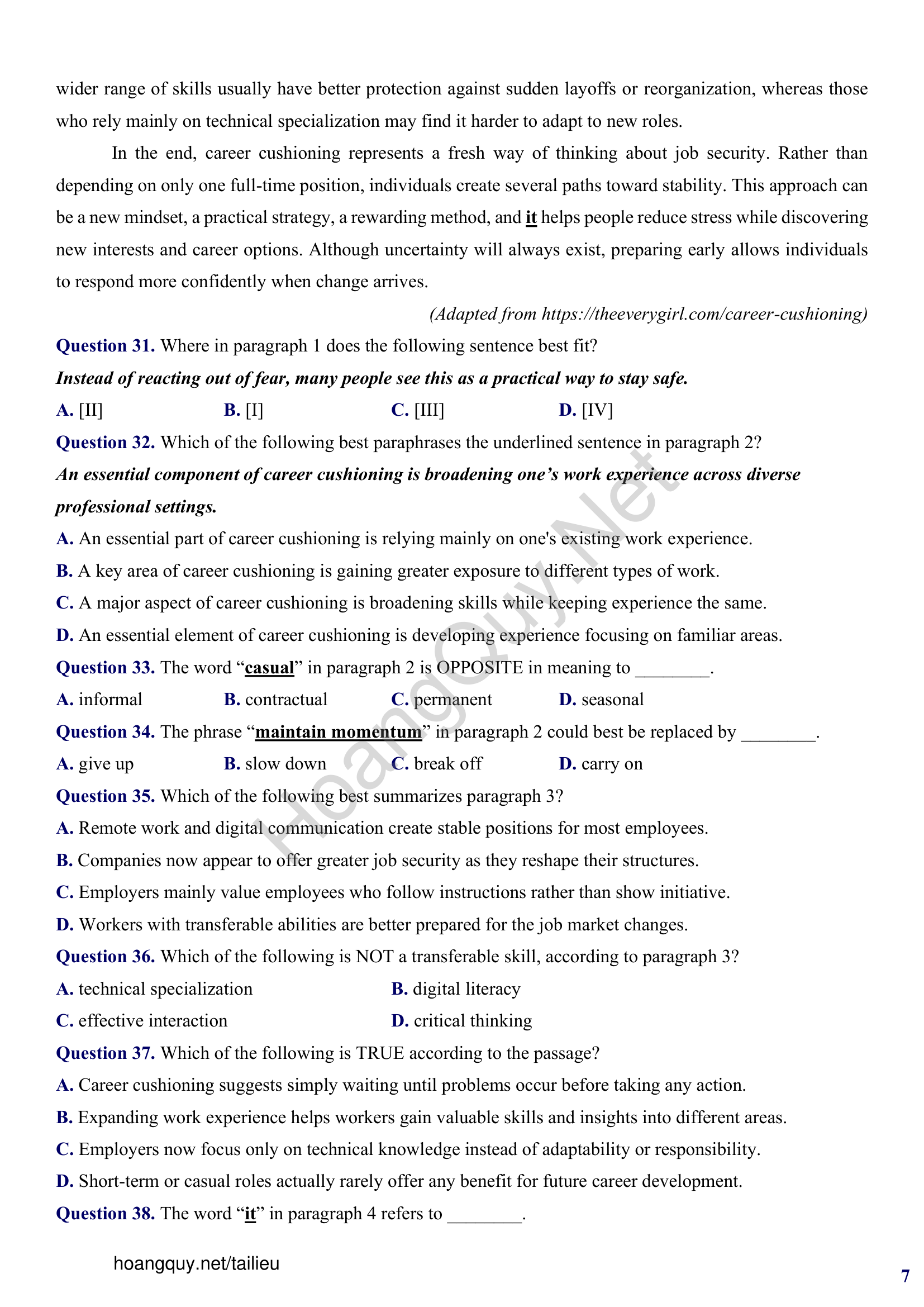
[I] In today’s quickly changing job market, where long-term employment is now a luxury, the idea of career cushioning has become increasingly important. [II] The rapid changes that followed restructuring, AI-driven change and mergers revealed how fast even stable jobs can disappear. [III] Career cushioning means preparing alternative options – such as improving skills, building networks, or exploring part-time opportunities – before problems arise. [IV]
An essential component of career cushioning is broadening one’s work experience across diverse professional settings. Many individuals apply for apprenticeships, join short training courses, or take on casual work to expand their abilities. These experiences provide useful skills and insight into different fields. Although they may be temporary, they can still offer security by opening new opportunities. This ongoing development widens opportunities and helps them maintain momentum even when market conditions shift unexpectedly.
The growth of remote work and digital communication has also changed how people prepare for possible job loss. Workers now recognize the importance of transferable skills – such as digital literacy, strong communication, and analytical thinking – which can be used in many professions. Employers are increasingly interested in adaptable employees who show initiative and responsibility. As companies, together with their departments, divisions, and workers, reshape their structures to respond to global changes, workers with a wider range of skills usually have better protection against sudden layoffs or reorganization, whereas those who rely mainly on technical specialization may find it harder to adapt to new roles.
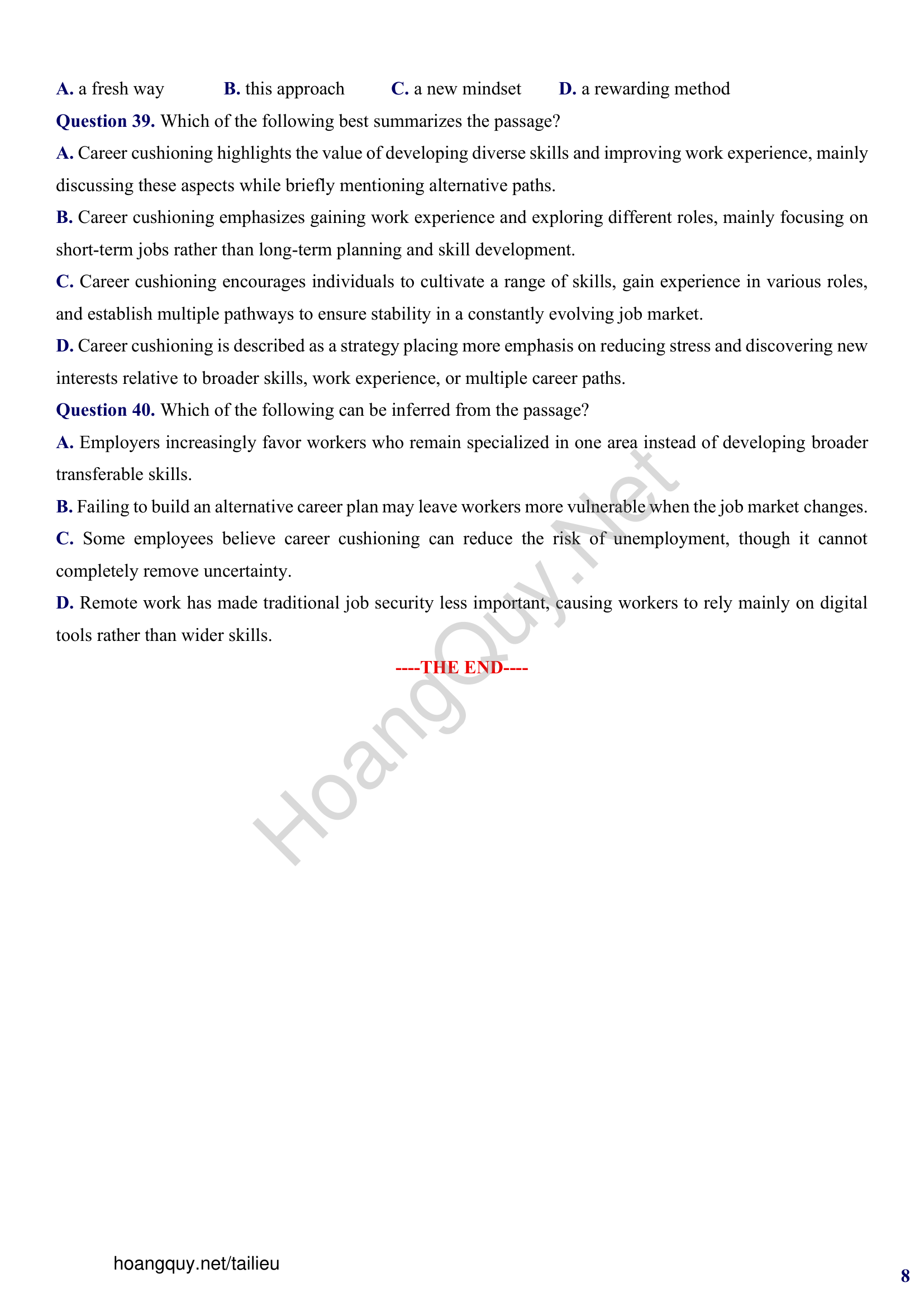
In the end, career cushioning represents a fresh way of thinking about job security. Rather than depending on only one full-time position, individuals create several paths toward stability. This approach can be a new mindset, a practical strategy, a rewarding method, and it helps people reduce stress while discovering new interests and career options. Although uncertainty will always exist, preparing early allows individuals to respond more confidently when change arrives.
(Adapted from https://theeverygirl.com/career-cushioning)
Câu 31: