
Đề thi thử Tiếng Anh THPT 2026 – LIÊN TRƯỜNG THPT ĐÔ LƯƠNG 3, PHAN ĐĂNG LƯU, YÊN THÀNH 2, TÂN KỲ là đề ôn tập môn Tiếng Anh dành cho học sinh lớp 12, bám sát nội dung SGK Bộ giáo dục. Đề thi do Giáo viên – giáo viên trường LIÊN TRƯƠNG THPT ĐÔ LƯƠNG 3, PHAN ĐĂNG LƯU, YÊN THÀNH 2, TÂN KỲ biên soạn năm 2026, với cấu trúc và độ khó đa dạng, từ mức độ nhận biết đến vận dụng cao, giúp các em làm quen với định dạng các bài Thi thử THPT Quốc Gia. Hãy truy cập detracnghiem.edu.vn để ôn luyện hiệu quả.
Để giúp các em học sinh ôn tập hiệu quả cho kỳ thi sắp tới, đề thi thử Tiếng Anh THPT này được xây dựng với hệ thống câu hỏi kỹ lưỡng, có đáp án và giải thích rõ ràng. Đây là tài liệu hữu ích cho học sinh lớp 12 muốn củng cố kiến thức và rèn luyện kỹ năng làm bài. Truy cập detracnghiem.edu.vn ngay hôm nay để nâng cao năng lực và tự tin bước vào kỳ thi quan trọng.
Đề thi thử Tiếng Anh THPT 2026 – LIÊN TRƯỜNG THPT ĐÔ LƯƠNG 3, PHAN ĐĂNG LƯU, YÊN THÀNH 2, TÂN KỲ
LINK PDF ĐỀ THI [gồm ĐỀ THI, ĐÁP ÁN, LỜI GIẢI]:
ĐỀ CHÍNH THỨC MÔN TIẾNG ANH
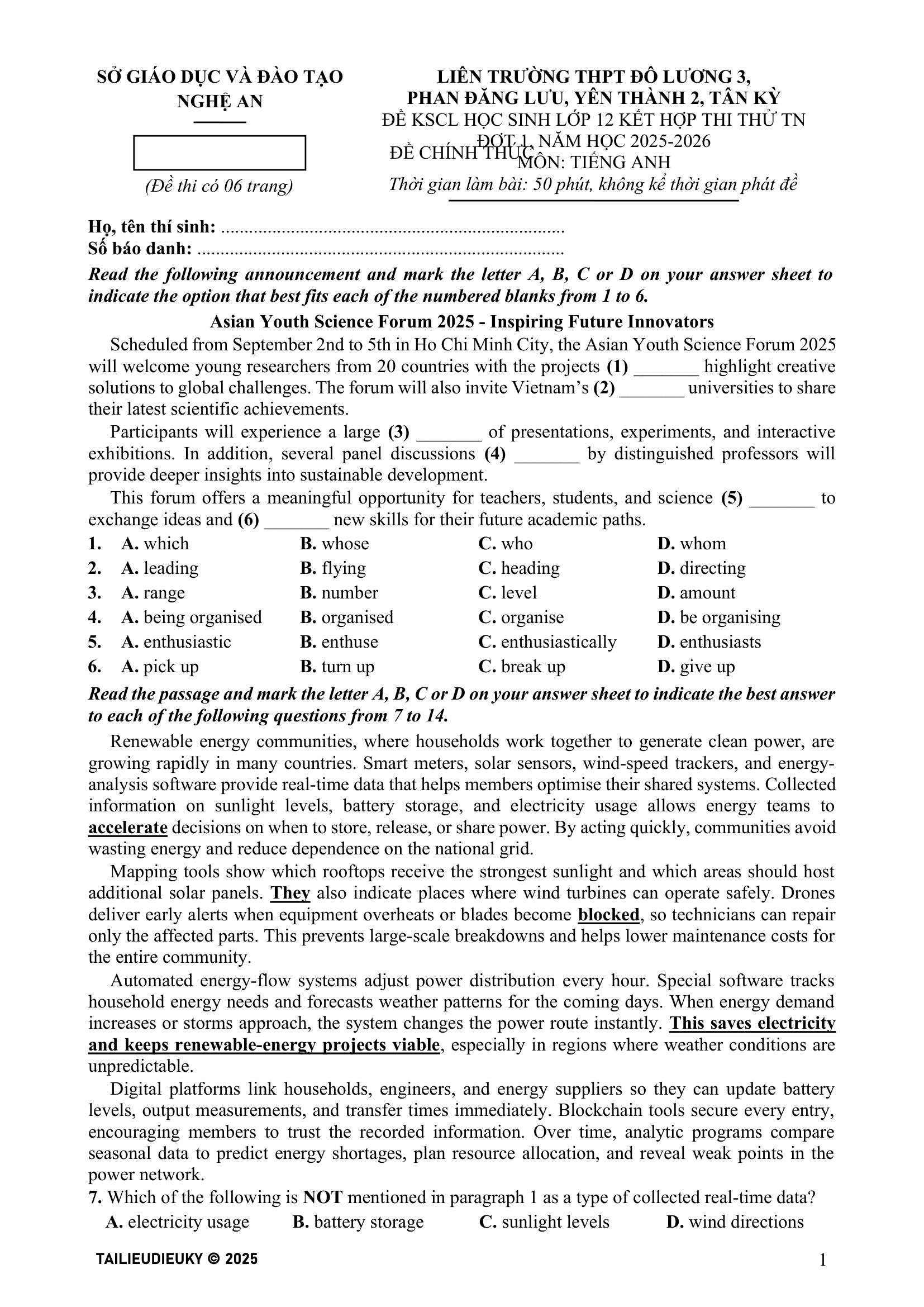
Read the following announcement and mark the letter A, B, C or D on your answer sheet to indicate the option that best fits each of the numbered blanks from 1 to 6.
Asian Youth Science Forum 2025 – Inspiring Future Innovators
Scheduled from September 2nd to 5th in Ho Chi Minh City, the Asian Youth Science Forum 2025 will welcome young researchers from 20 countries with the projects (1)________ highlight creative solutions to global challenges. The forum will also invite Vietnam’s (2)________ universities to share their latest scientific achievements.
Participants will experience a large (3)________ of presentations, experiments, and interactive exhibitions. In addition, several panel discussions (4)________ by distinguished professors will provide deeper insights into sustainable development.
This forum offers a meaningful opportunity for teachers, students, and science (5)________ to exchange ideas and (6)________ new skills for their future academic paths.
Câu 1:
A. which
B. whose
C. who
D. whom
Câu 2:
A. leading
B. flying
C. heading
D. directing
Câu 3:
A. range
B. number
C. level
D. amount
Câu 4:
A. being organised
B. organised
C. organise
D. be organising
Câu 5:
A. enthusiastic
B. enthuse
C. enthusiastically
D. enthusiasts
Câu 6:
A. pick up
B. turn up
C. break up
D. give up
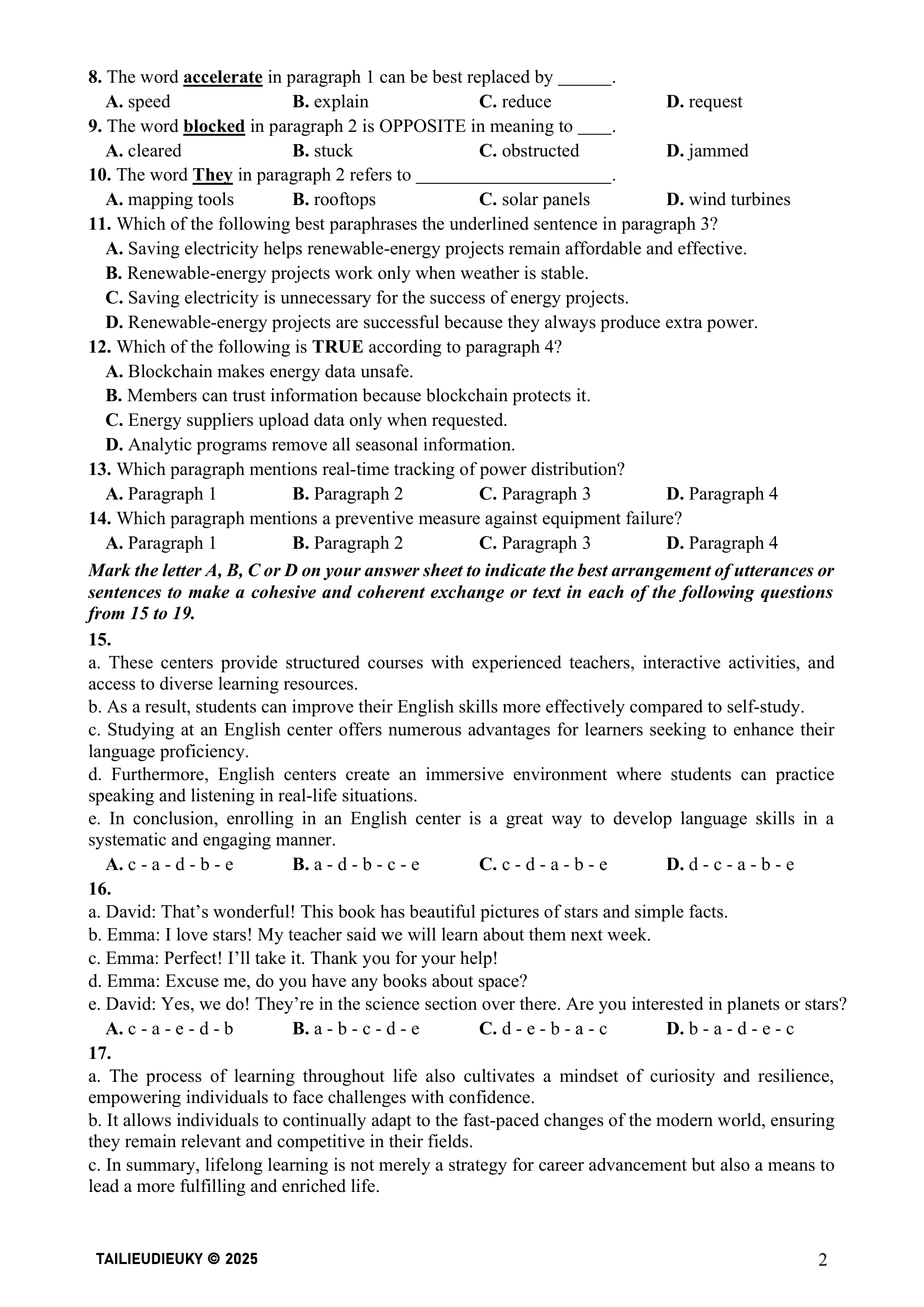
Renewable energy communities, where households work together to generate clean power, are growing rapidly in many countries. Smart meters, solar sensors, wind-speed trackers, and energy-analysis software provide real-time data that helps members optimise their shared systems. Collected information on sunlight levels, battery storage, and electricity usage allows energy teams to accelerate decisions on when to store, release, or share power. By acting quickly, communities avoid wasting energy and reduce dependence on the national grid.
Mapping tools show which rooftops receive the strongest sunlight and which areas should host additional solar panels. They also indicate places where wind turbines can operate safely. Drones deliver early alerts when equipment overheats or blades become blocked, so technicians can repair only the affected parts. This prevents large-scale breakdowns and helps lower maintenance costs for the entire community.
Automated energy-flow systems adjust power distribution every hour. Special software tracks household energy needs and forecasts weather patterns for the coming days. When energy demand increases or storms approach, the system changes the power route instantly. This saves electricity and keeps renewable-energy projects viable, especially in regions where weather conditions are unpredictable.
Digital platforms link households, engineers, and energy suppliers so they can update battery levels, output measurements, and transfer times immediately. Blockchain tools secure every entry, encouraging members to trust the recorded information. Over time, analytic programs compare seasonal data to predict energy shortages, plan resource allocation, and reveal weak points in the power network.
Câu 7: Which of the following is NOT mentioned in paragraph 1 as a type of collected real-time data?
A. electricity usage
B. battery storage
C. sunlight levels
D. wind directions
Câu 8: The word accelerate in paragraph 1 can be best replaced by _______.
A. speed
B. explain
C. reduce
D. request
Câu 9: The word blocked in paragraph 2 is OPPOSITE in meaning to _______.
A. cleared
B. stuck
C. obstructed
D. jammed
Câu 10: The word They in paragraph 2 refers to _______.
A. mapping tools
B. rooftops
C. solar panels
D. wind turbines
Câu 11: Which of the following best paraphrases the underlined sentence in paragraph 3?
A. Saving electricity helps renewable-energy projects remain affordable and effective.
B. Renewable-energy projects work only when weather is stable.
C. Saving electricity is unnecessary for the success of energy projects.
D. Renewable-energy projects are successful because they always produce extra power.
Câu 12: Which of the following is TRUE according to paragraph 4?
A. Blockchain makes energy data unsafe.
B. Members can trust information because blockchain protects it.
C. Energy suppliers upload data only when requested.
D. Analytic programs remove all seasonal information.
Câu 13: Which paragraph mentions real-time tracking of power distribution?
A. Paragraph 1
B. Paragraph 2
C. Paragraph 3
D. Paragraph 4
Câu 14: Which paragraph mentions a preventive measure against equipment failure?
A. Paragraph 1
B. Paragraph 2
C. Paragraph 3
D. Paragraph 4
Câu 15: a. These centers provide structured courses with experienced teachers, interactive activities, and access to diverse learning resources.
b. As a result, students can improve their English skills more effectively compared to self-study.
c. Studying at an English center offers numerous advantages for learners seeking to enhance their language proficiency.
d. Furthermore, English centers create an immersive environment where students can practice speaking and listening in real-life situations.
e. In conclusion, enrolling in an English center is a great way to develop language skills in a systematic and engaging manner.
A. c – a – d – b – e
B. a – d – b – c – e
C. c – d – a – b – e
D. d – c – a – b – e
Câu 16: a. David: That’s wonderful! This book has beautiful pictures of stars and simple facts.
b. Emma: I love stars! My teacher said we will learn about them next week.
c. Emma: Perfect! I’ll take it. Thank you for your help!
d. Emma: Excuse me, do you have any books about space?
e. David: Yes, we do! They’re in the science section over there. Are you interested in planets or stars?
A. a – c – e – d – b
B. a – b – e – c – d – e
C. d – e – b – a – c
D. b – a – d – c – e
Câu 17: a. The process of learning throughout life also cultivates a mindset of curiosity and resilience, empowering individuals to face challenges with confidence.
b. It allows individuals to continually adapt to the fast-paced changes of the modern world, ensuring they remain relevant and competitive in their fields.
c. In summary, lifelong learning is not merely a strategy for career advancement but also a means to lead a more fulfilling and enriched life.
d. Lifelong learning is a commitment that you need to make because it is essential and should be one of your top priorities.
e. Furthermore, engaging in continuous learning enhances critical thinking and problem-solving skills, fostering both personal and professional growth.
A. d – b – c – e – a
B. d – e – c – a – b
C. d – b – e – a – c
D. d – c – a – b – e
Câu 18: a. Sarah: Look! My new smart glasses can translate signs. I point, and it shows me words in English!
b. Sarah: Yes, here you are. Just tap the side button and look at the text. It’s so easy!
c. Tom: Wow! Can I try them? I want to read that Japanese menu.
A. a – c – b
B. a – b – c
C. c – a – b
D. b – c – a
Câu 19: a. Dear Sir,
b. Unfortunately, due to unforeseen challenges, I was unable to meet the original deadline.
c. I truly appreciate your patience and understanding regarding this matter.
d. I sincerely apologize for not finishing the plan on time as expected.
e. I am currently making the final adjustments and will submit the completed plan by the end of the week.
f. Please let me know if you have any urgent concerns or if there is anything I can do to minimize the inconvenience.
Your faithfully,
A. a – b – c – d – e
B. b – c – a – b – d – e
C. c – b – a – d – e
D. a – d – b – e – c
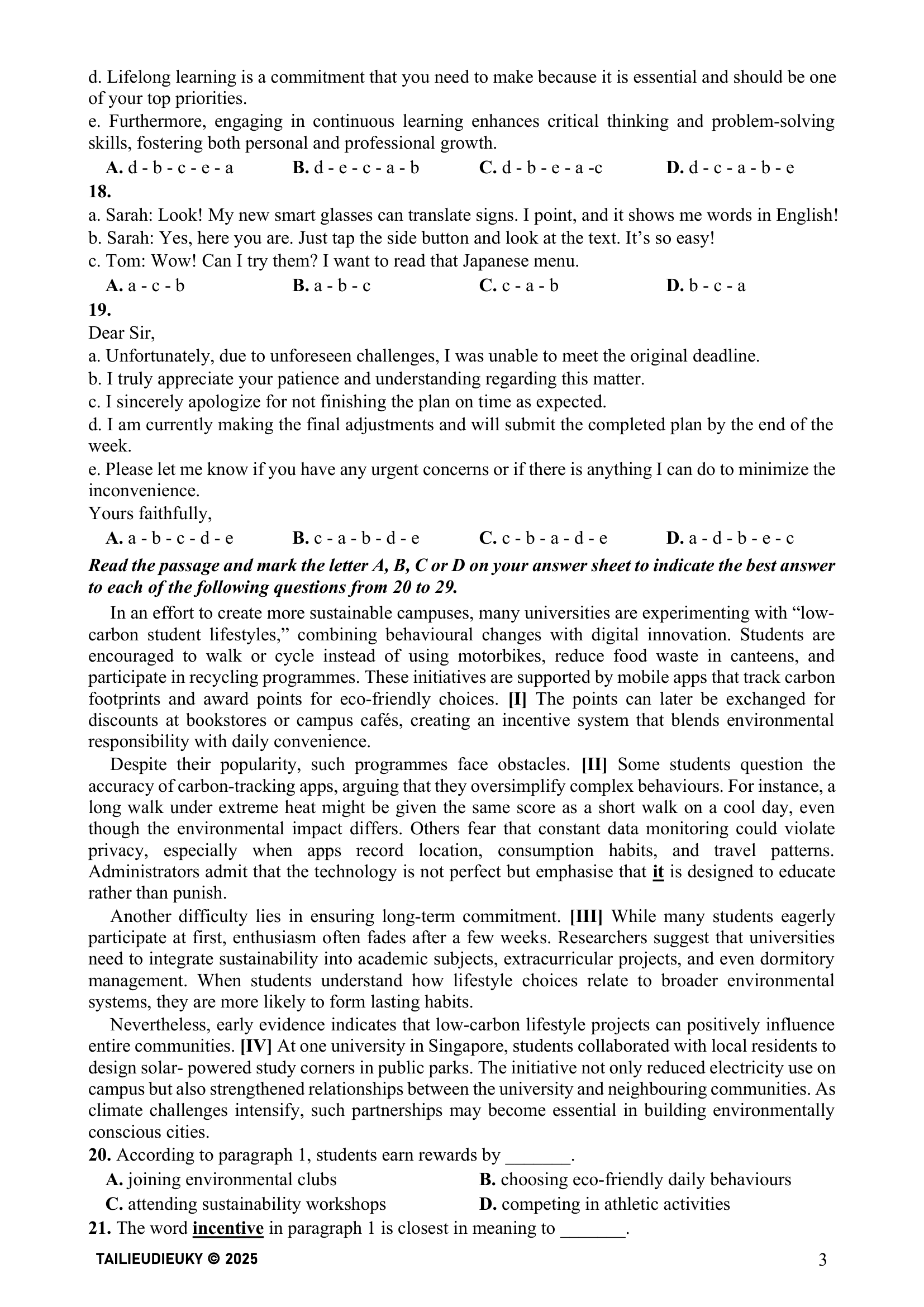
In an effort to create more sustainable campuses, many universities are experimenting with “low-carbon student lifestyles,” combining behavioural changes with digital innovation. Students are encouraged to walk or cycle instead of using motorbikes, reduce food waste in canteens, and participate in recycling programmes. These initiatives are supported by mobile apps that track carbon footprints and award points for eco-friendly choices. [I] The points can later be exchanged for discounts at bookstores or campus cafés, creating an incentive system that blends environmental responsibility with daily convenience.
Despite their popularity, such programmes face obstacles. [II] Some students question the accuracy of carbon-tracking apps, arguing that they oversimplify complex behaviours. For instance, a long walk under extreme heat might be given the same score as a short walk on a cool day, even though the environmental impact differs. Others fear that constant data monitoring could violate privacy, especially when apps record location, consumption habits, and travel patterns. Administrators admit that the technology is not perfect but emphasise that it is designed to educate rather than punish.
Another difficulty lies in ensuring long-term commitment. [III] While many students eagerly participate at first, enthusiasm often fades after a few weeks. Researchers suggest that universities need to integrate sustainability into academic subjects, extracurricular projects, and even dormitory management. When students understand how lifestyle choices relate to broader environmental systems, they are more likely to form lasting habits.
Nevertheless, early evidence indicates that low-carbon lifestyle projects can positively influence entire communities. [IV] At one university in Singapore, students collaborated with local residents to design solar-powered study corners in public parks. The initiative not only reduced electricity use on campus but also strengthened relationships between the university and neighbouring communities. As climate challenges intensify, such partnerships may become essential in building environmentally conscious cities.
Câu 20: According to paragraph 1, students earn rewards by _______.
A. joining environmental clubs
B. choosing eco-friendly daily behaviours
C. attending sustainability workshops
D. competing in athletic activities
Câu 21: The word incentive in paragraph 1 is closest in meaning to _______.
A. encouragement
B. experiment
C. restriction
D. investment
Câu 22: What is one criticism of carbon-tracking apps?
A. They send inaccurate discount vouchers.
B. They oversimplify the measurement of behaviours.
C. They promote unhealthy dieting in canteens.
D. They encourage students to avoid walking.
Câu 23: The word it in paragraph 2 refers to _______.
A. the technology
B. the university
C. the discount system
D. the environment
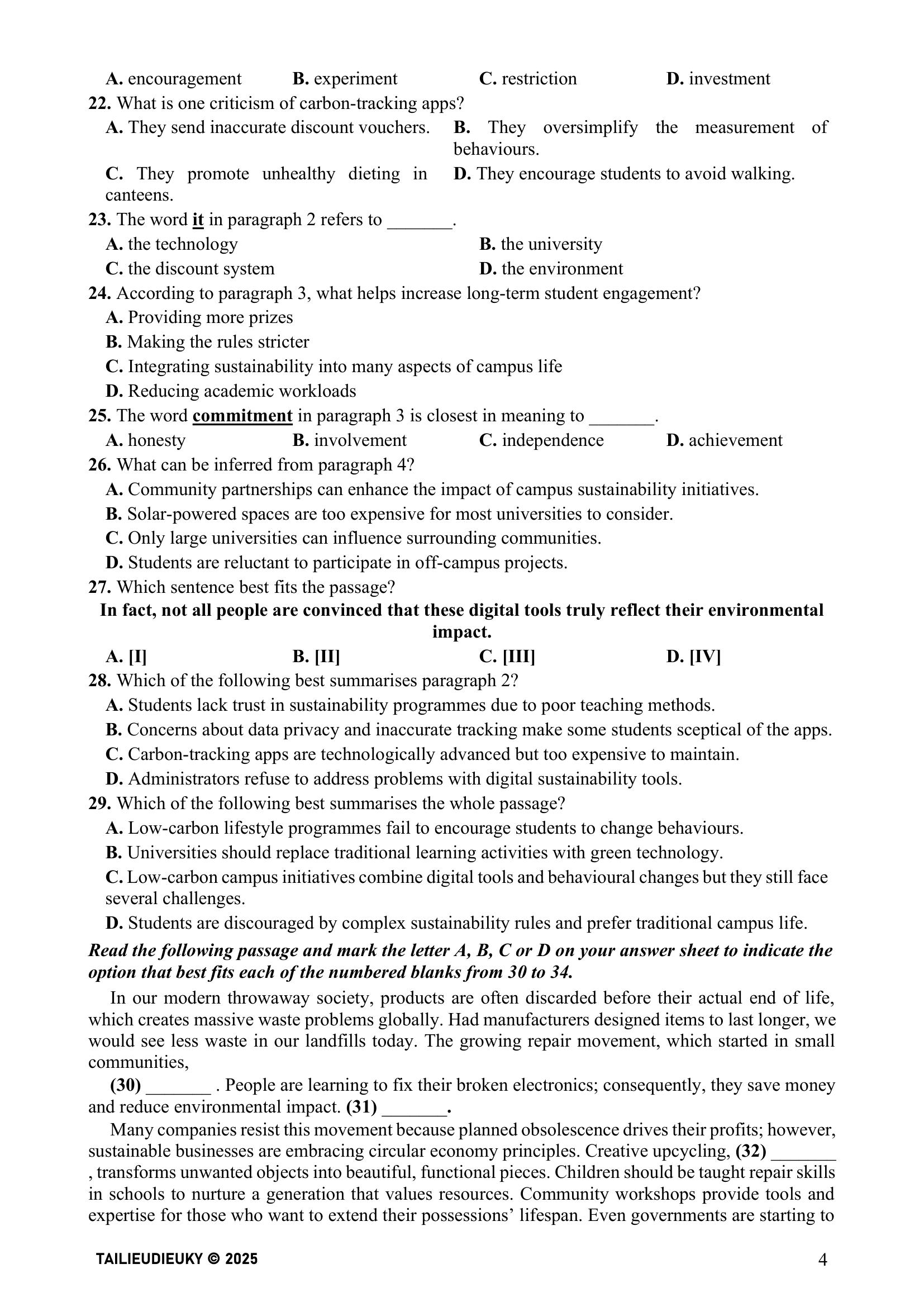
Câu 24: According to paragraph 3, what helps increase long-term student engagement?
A. Providing more prizes
B. Making the rules stricter
C. Integrating sustainability into many aspects of campus life
D. Reducing academic workloads
Câu 25: The word commitment in paragraph 3 is closest in meaning to _______.
A. honesty
B. involvement
C. independence
D. achievement
Câu 26: What can be inferred from paragraph 4?
A. Community partnerships can enhance the impact of campus sustainability initiatives.
B. Solar-powered spaces are too expensive for most universities to consider.
C. Only large universities can influence surrounding communities.
D. Students are reluctant to participate in off-campus projects.
Câu 27: Which sentence best fits the passage?
In fact, not all people are convinced that these digital tools truly reflect their environmental impact.
A. [I]
B. [II]
C. [III]
D. [IV]
Câu 28: Which of the following best summarises paragraph 2?
A. Students lack trust in sustainability programmes due to poor teaching methods.
B. Concerns about data privacy and inaccurate tracking make some students sceptical of the apps.
C. Carbon-tracking apps are technologically advanced but too expensive to maintain.
D. Administrators refuse to address problems with digital sustainability tools.
Câu 29: Which of the following best summarises the whole passage?
A. Low-carbon student lifestyle programmes fail to encourage students to change behaviours.
B. Universities should replace traditional learning activities with green technology.
C. Low-carbon campus initiatives combine digital tools and behavioural changes but they still face several challenges.
D. Students are discouraged by complex sustainability rules and prefer traditional campus life.
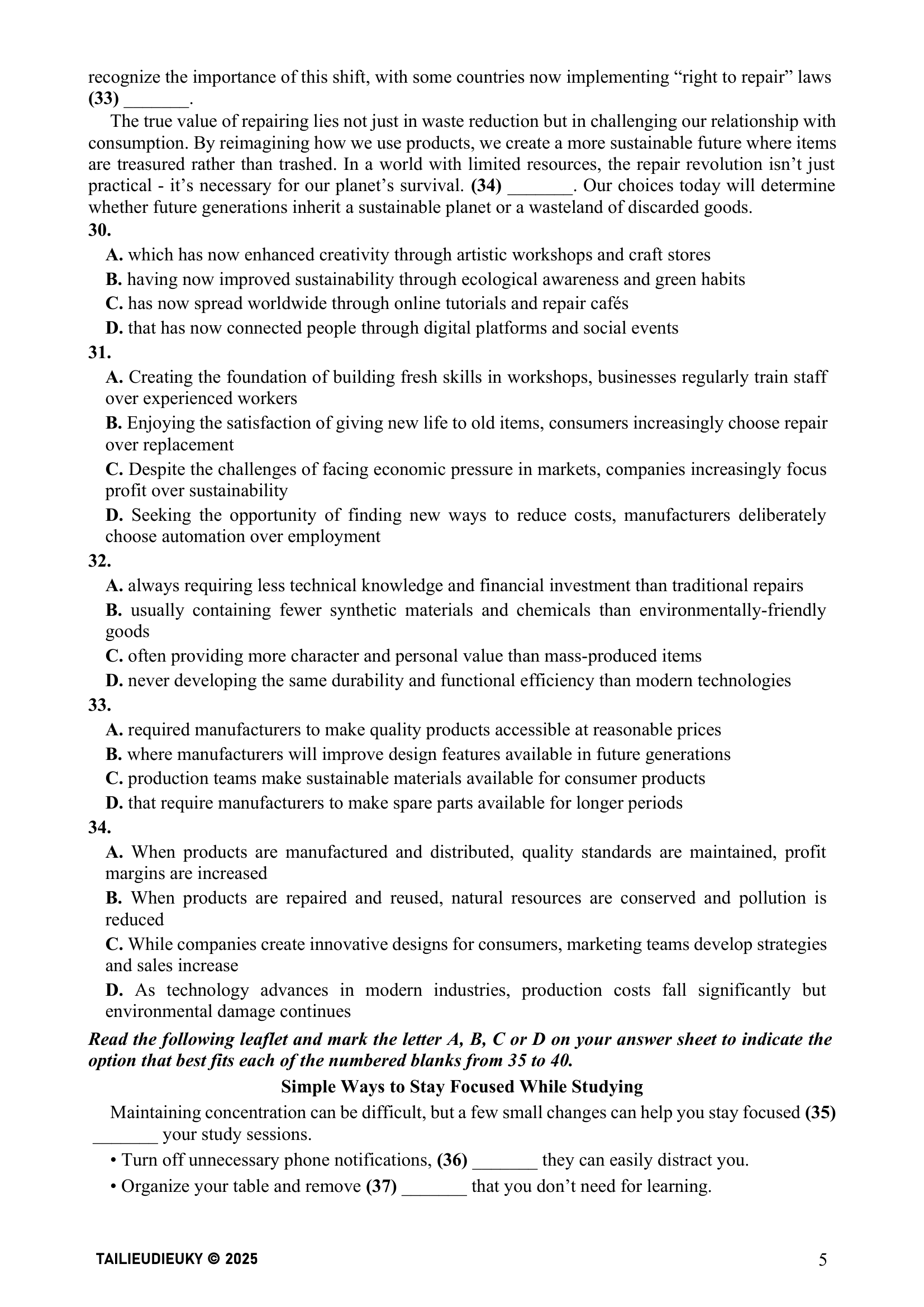
In our modern throwaway society, products are often discarded before their actual end of life, which creates massive waste problems globally. Had manufacturers designed items to last longer, we would see less waste in our landfills today. The growing repair movement, which started in small communities, (30)____________________________. People are learning to fix their broken electronics; consequently, they save money and reduce environmental impact. (31)____________________________.
Many companies resist this movement because planned obsolescence drives their profits; however, sustainable businesses are embracing circular economy principles. Creative upcycling, (32)____________________________, transforms unwanted objects into beautiful, functional pieces. Children should be taught repair skills in schools to nurture a generation that values resources. Community workshops provide tools and expertise for those who want to extend their possessions’ lifespan. Even governments are starting to recognize the importance of this shift, with some countries now implementing “right to repair” laws. (33)____________________________.
The true value of repairing lies not just in waste reduction but in challenging our relationship with consumption. By reimagining how we use products, we create a more sustainable future where items are treasured rather than trashed. In a world with limited resources, the repair revolution isn’t just practical – it’s necessary for our planet’s survival. (34)____________________________. Our choices today will determine whether future generations inherit a sustainable planet or a wasteland of discarded goods.
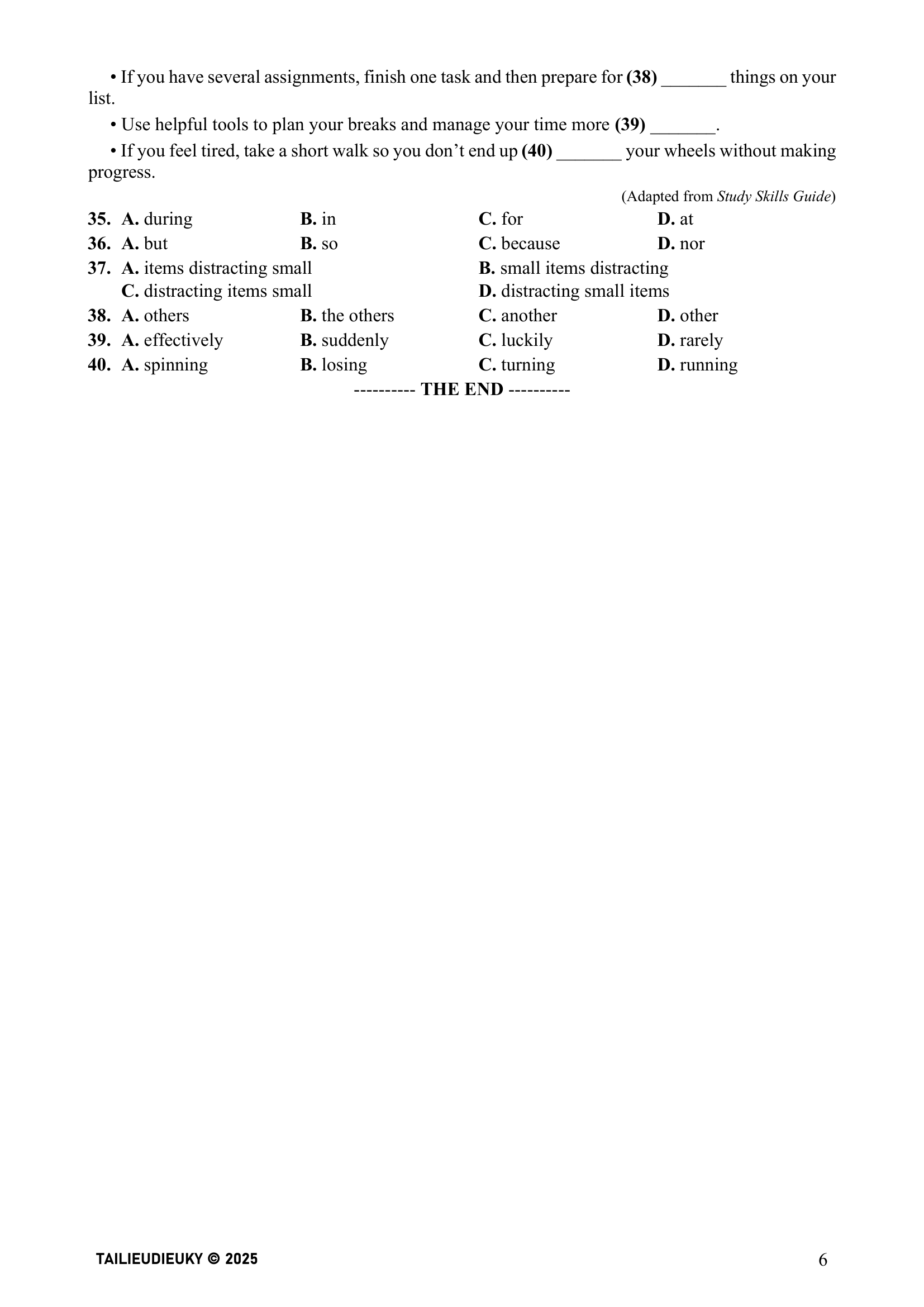
Câu 30:
A. which has now enhanced creativity through artistic workshops and craft stores
B. having now improved sustainability through ecological awareness and green habits
C. has now spread worldwide through online tutorials and repair cafés
D. that has now connected people through digital platforms and social events
Câu 31:
A. Creating the foundation of building fresh skills in workshops, businesses regularly train staff over experienced workers
B. Enjoying the satisfaction of giving new life to old items, consumers increasingly choose repair over replacement
C. Despite the challenges of facing economic pressure in markets, companies increasingly focus profits over sustainability
D. Seeking the opportunity of finding new ways to reduce costs, manufacturers deliberately choose automation over employment
Câu 32:
A. always requiring less technical knowledge and financial investment than traditional repairs
B. usually containing fewer synthetic materials and chemicals than environmentally-friendly goods
C. often providing more character and personal value than mass-produced items
D. never developing the same durability and functional efficiency than modern technologies
Câu 33:
A. required manufacturers to make quality products accessible at reasonable prices
B. where manufacturers will improve design features available in future generations
C. production teams make sustainable materials available for consumer products
D. that require manufacturers to make spare parts available for longer periods
Câu 34:
A. When products are manufactured and distributed, quality standards are maintained, profit margins are increased
B. When products are repaired and reused, natural resources are conserved and pollution is reduced
C. While companies create innovative designs for consumers, marketing teams develop strategies and sales increase
D. As technology advances in modern industries, production costs fall significantly but environmental damage continues
Read the following leaflet and mark the letter A, B, C or D on your answer sheet to indicate the option that best fits each of the numbered blanks from 35 to 40.
Simple Ways to Stay Focused While Studying
Maintaining concentration can be difficult, but a few small changes can help you stay focused (35)_________ your study sessions.
• Turn off unnecessary phone notifications, (36)_________ they can easily distract you.
• Organize your table and remove (37)_________ that you don’t need for learning.
• If you have several assignments, finish one task and then prepare for (38)_________ things on your list.
• Use helpful tools to plan your breaks and manage your time more (39)_________.
• If you feel tired, take a short walk so you don’t end up (40)_________ your wheels without making progress.
(Adapted from Study Skills Guide)
Câu 35:
A. during
B. in
C. for
D. at
Câu 36:
A. but
B. so
C. because
D. nor
Câu 37:
A. items distracting small
B. small items distracting
C. distracting items small
D. distracting small items
Câu 38:
A. others
B. the others
C. another
D. other
Câu 39:
A. effectively
B. suddenly
C. luckily
D. rarely
Câu 40:
A. spinning
B. losing
C. turning
D. running

