
Đề thi thử Tiếng Anh THPT 2025 – Sở GDĐT Nam Định là đề ôn tập môn Tiếng Anh dành cho học sinh lớp 12, bám sát nội dung SGK Bộ giáo dục. Đề thi do Giáo viên – giáo viên trường Sở GDĐT Nam Định biên soạn năm 2025, với các câu hỏi được thiết kế từ mức độ nhận biết đến vận dụng cao. Đây là tài liệu quý giá giúp các em chuẩn bị tốt nhất cho kỳ Thi thử THPT Quốc Gia tại detracnghiem.edu.vn.
Để tối ưu hiệu quả việc thi thử Tiếng Anh THPT, bộ đề này được xây dựng với các câu hỏi chất lượng, được biên soạn kỹ lưỡng và đi kèm giải thích rõ ràng, chi tiết cho từng đáp án, giúp học sinh lớp 12 nắm vững kiến thức. Truy cập detracnghiem.edu.vn ngay hôm nay để trải nghiệm kho đề thi phong phú, từ đó các em có thể nâng cao năng lực và tự tin bước vào kỳ thi chính thức.
Đề thi thử Tiếng Anh THPT 2025 – Sở GDĐT Nam Định
LINK PDF ĐỀ THI [gồm ĐỀ THI, ĐÁP ÁN, LỜI GIẢI]:
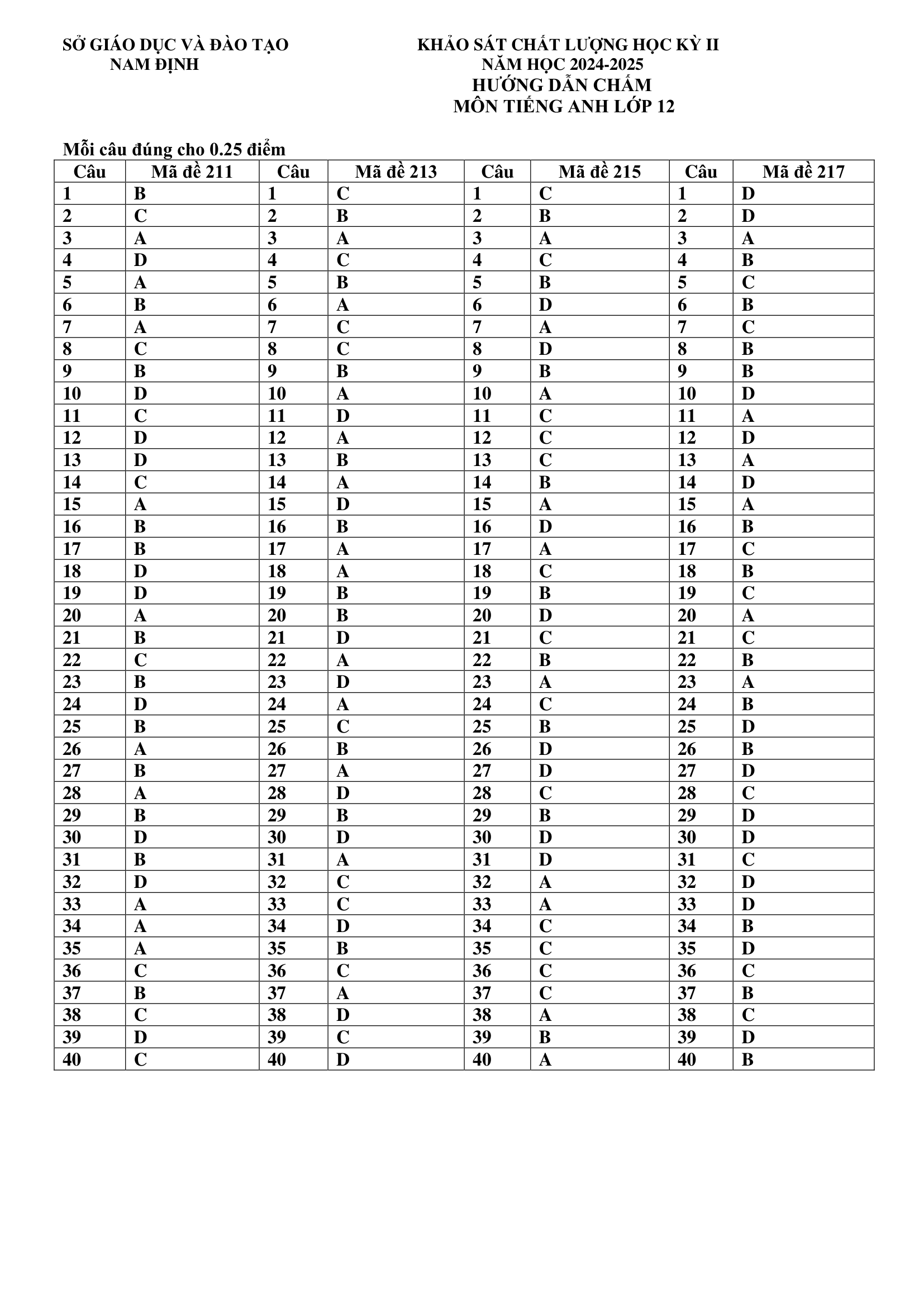
Mã đề 211
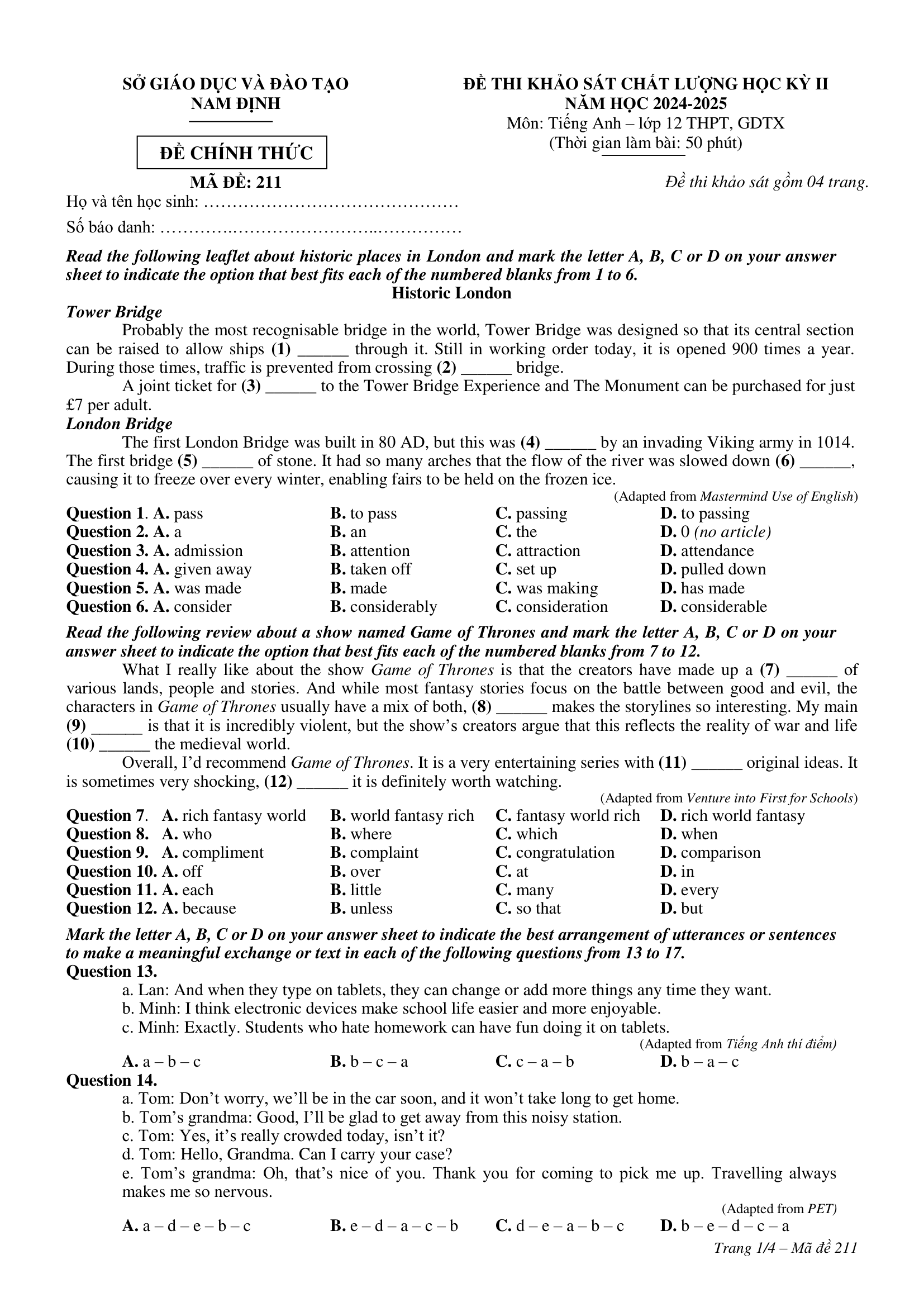
Read the following leaflet about historic places in London and mark the letter A, B, C or D on your answer sheet to indicate the option that best fits each of the numbered blanks from 1 to 6.
Historic London
Tower Bridge
Probably the most recognisable bridge in the world, Tower Bridge was designed so that its central section can be raised to allow ships (1) _____ through it. Still in working order today, it is opened 900 times a year. During those times, traffic is prevented from crossing (2) _____ bridge.
A joint ticket for (3) _____ to the Tower Bridge Experience and The Monument can be purchased for just £7 per adult.
London Bridge
The first London Bridge was built in 80 AD, but this was (4) _____ by an invading Viking army in 1014. The first bridge (5) _____ of stone. It had so many arches that the flow of the river was slowed down (6) _____, causing it to freeze over every winter, enabling fairs to be held on the frozen ice.
(Adapted from Mastermind Use of English)
Câu 1:
A. pass
B. to pass
C. passing
D. to passing
Câu 2:
A. a
B. an
C. the
D. 0 (no article)
Câu 3:
A. admission
B. attention
C. attraction
D. attendance
Câu 4:
A. given away
B. taken off
C. set up
D. pulled down
Câu 5:
A. was made
B. made
C. was making
D. has made
Câu 6:
A. consider
B. considerably
C. consideration
D. considerable
Read the following review about a show named Game of Thrones and mark the letter A, B, C or D on your answer sheet to indicate the option that best fits each of the numbered blanks from 7 to 12.
What I really like about the show Game of Thrones is that the creators have made up a (7) _____ of various lands, people and stories. And while most fantasy stories focus on the battle between good and evil, the characters in Game of Thrones usually have a mix of both, (8) _____ makes the storylines so interesting. My main (9) _____ is that it is incredibly violent, but the show’s creators argue that this reflects the reality of war and life (10) _____ the medieval world.
Overall, I’d recommend Game of Thrones. It is a very entertaining series with (11) _____ original ideas. It is sometimes very shocking, (12) _____ it is definitely worth watching.
(Adapted from Venture into First for Schools)
Câu 7:
A. rich fantasy world
B. world fantasy rich
C. fantasy world rich
D. rich world fantasy
Câu 8:
A. who
B. where
C. which
D. when
Câu 9:
A. compliment
B. complaint
C. congratulation
D. comparison
Câu 10:
A. off
B. over
C. at
D. in
Câu 11:
A. each
B. little
C. many
D. every
Câu 12:
A. because
B. unless
C. so that
D. but
Câu 13: Mark the letter A, B, C or D on your answer sheet to indicate the best arrangement of utterances or sentences to make a meaningful exchange or text in each of the following questions from 13 to 17.
a. Lan: And when they type on tablets, they can change or add more things any time they want.
b. Minh: I think electronic devices make school life easier and more enjoyable.
c. Minh: Exactly. Students who hate homework can have fun doing it on tablets.
(Adapted from Tiếng Anh thí điểm)
A. a – b – c
B. b – c – a
C. c – a – b
D. b – a – c
Câu 14: a. Tom: Don’t worry, we’ll be in the car soon, and it won’t take long to get home.
b. Tom’s grandma: Good, I’ll be glad to get away from this noisy station.
c. Tom: Yes, it’s really crowded today, isn’t it?
d. Tom: Hello, Grandma. Can I carry your case?
e. Tom’s grandma: Oh, that’s nice of you. Thank you for coming to pick me up. Travelling always makes me so nervous.
(Adapted from PET)
A. a – d – e – b – c
B. e – d – a – c – b
C. d – e – a – b – c
D. b – e – d – c – a
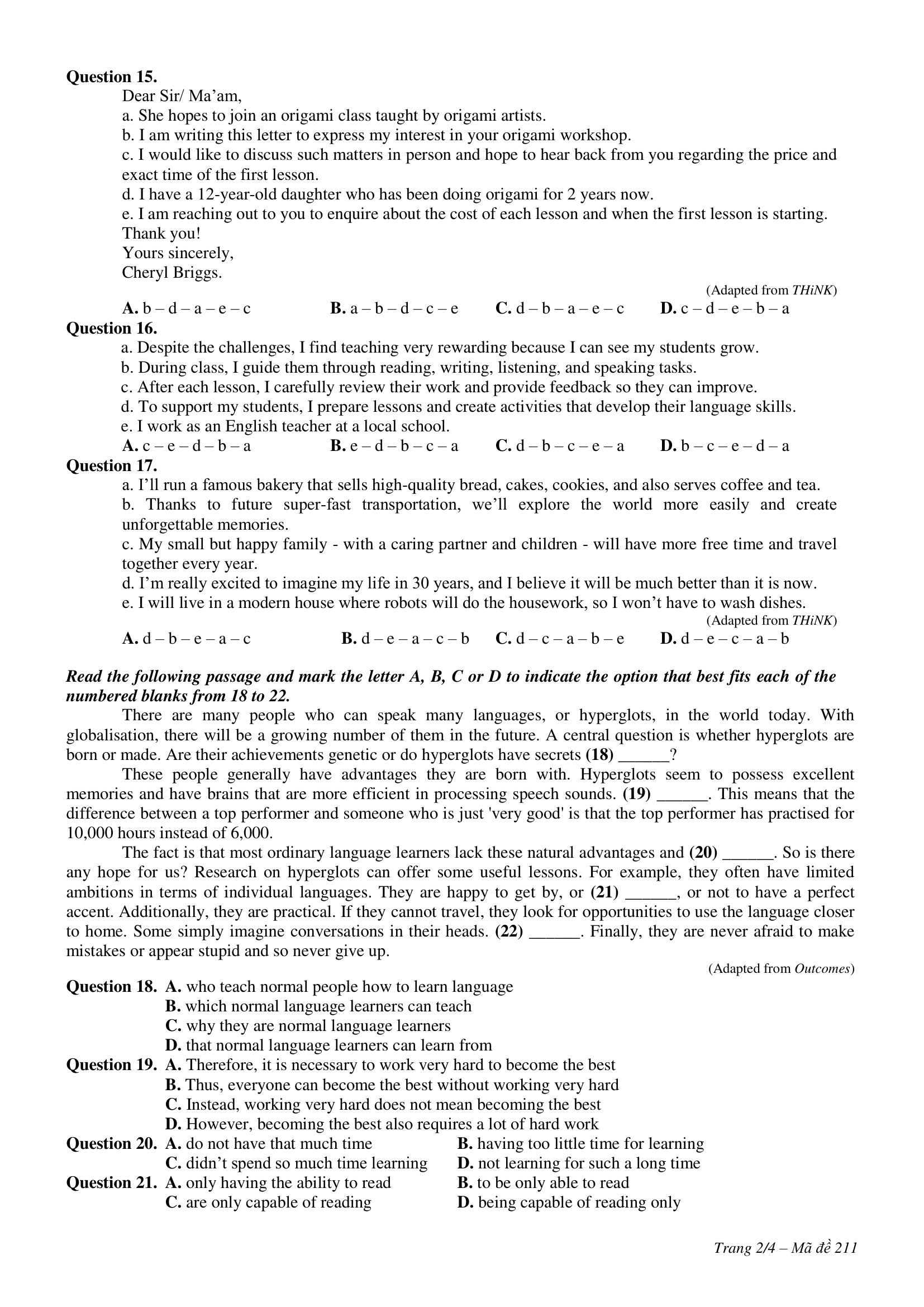
Câu 15: Dear Sir/ Ma’am,
a. She hopes to join an origami class taught by origami artists.
b. I am writing this letter to express my interest in your origami workshop.
c. I would like to discuss such matters in person and hope to hear back from you regarding the price and exact time of the first lesson.
d. I have a 12-year-old daughter who has been doing origami for 2 years now.
e. I am reaching out to you to enquire about the cost of each lesson and when the first lesson is starting.
Thank you!
Yours sincerely,
Cheryl Briggs.
(Adapted from THiNK)
A. b – d – a – e – c
B. a – b – d – c – e
C. d – b – a – e – c
D. c – d – e – b – a
Câu 16: a. Despite the challenges, I find teaching very rewarding because I can see my students grow.
b. During class, I guide them through reading, writing, listening, and speaking tasks.
c. After each lesson, I carefully review their work and provide feedback so they can improve.
d. To support my students, I prepare lessons and create activities that develop their language skills.
e. I work as an English teacher at a local school.
A. c – e – d – b – a
B. e – d – b – c – a
C. d – b – c – e – a
D. b – c – e – d – a
Câu 17: a. I’ll run a famous bakery that sells high-quality bread, cakes, cookies, and also serves coffee and tea.
b. Thanks to future super-fast transportation, we’ll explore the world more easily and create unforgettable memories.
c. My small but happy family – with a caring partner and children – will have more free time and travel together every year.
d. I’m really excited to imagine my life in 30 years, and I believe it will be much better than it is now.
e. I will live in a modern house where robots will do the housework, so I won’t have to wash dishes.
(Adapted from THiNK)
A. d – b – e – a – c
B. d – e – a – c – b
C. d – c – a – b – e
D. d – e – c – a – b
Read the following passage and mark the letter A, B, C or D to indicate the option that best fits each of the numbered blanks from 18 to 22.
There are many people who can speak many languages, or hyperglots, in the world today. With globalisation, there will be a growing number of them in the future. A central question is whether hyperglots are born or made. Are their achievements genetic or do hyperglots have secrets (18) _____?
These people generally have advantages they are born with. Hyperglots seem to possess excellent memories and have brains that are more efficient in processing speech sounds. (19) _____. This means that the difference between a top performer and someone who is just ‘very good’ is that the top performer has practised for 10,000 hours instead of 6,000.
The fact is that most ordinary language learners lack these natural advantages and (20) _____. So is there any hope for us? Research on hyperglots can offer some useful lessons. For example, they often have limited ambitions in terms of individual languages. They are happy to get by, or (21) _____, or not to have a perfect accent. Additionally, they are practical. If they cannot travel, they look for opportunities to use the language closer to home. Some simply imagine conversations in their heads. (22) _____. Finally, they are never afraid to make mistakes or appear stupid and so never give up.
(Adapted from Outcomes)
Câu 18:
A. who teach normal people how to learn language
B. which normal language learners can teach
C. why they are normal language learners
D. that normal language learners can learn from
Câu 19:
A. Therefore, it is necessary to work very hard to become the best
B. Thus, everyone can become the best without working very hard
C. Instead, working very hard does not mean becoming the best
D. However, becoming the best also requires a lot of hard work
Câu 20:
A. do not have that much time
B. having too little time for learning
C. didn’t spend so much time learning
D. not learning for such a long time
Câu 21:
A. only having the ability to read
B. to be only able to read
C. are only capable of reading
D. being capable of reading only
Câu 22:
A. Techniques like putting words in context are useless for them
B. They always avoid learning words by putting them in context
C. They also use other techniques like learning words in context
D. Other techniques like using words in context are not necessary
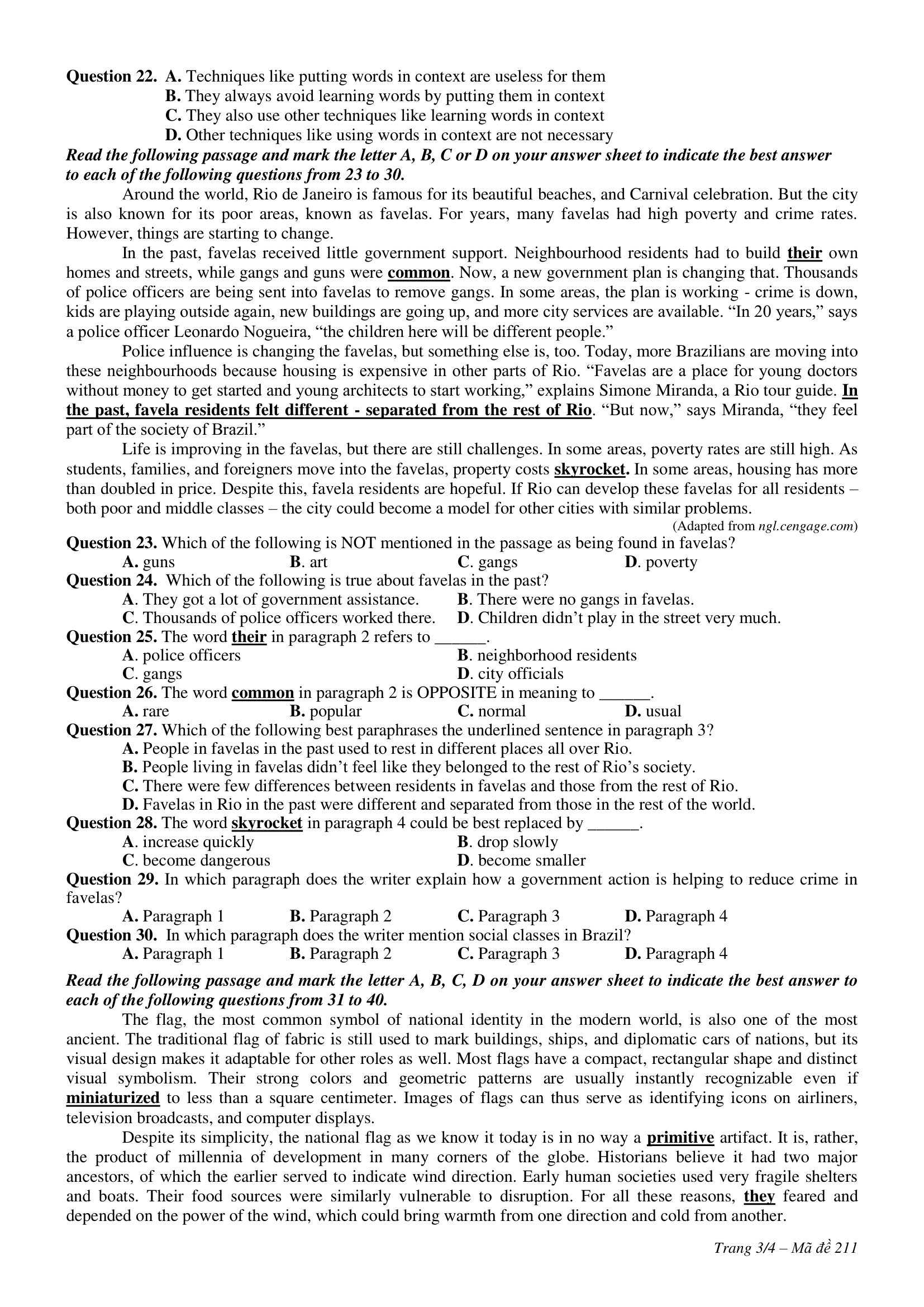
Read the following passage and mark the letter A, B, C or D on your answer sheet to indicate the best answer to each of the following questions from 23 to 30.
Around the world, Rio de Janeiro is famous for its beautiful beaches, and Carnival celebration. But the city is also known for its poor areas, known as favelas. For years, many favelas had high poverty and crime rates. However, things are starting to change.
In the past, favelas received little government support. Neighbourhood residents had to build their own homes and streets, while gangs and guns were common. Now, a new government plan is changing that. Thousands of police officers are being sent into favelas to remove gangs. In some areas, the plan is working – crime is down, kids are playing outside again, new buildings are going up, and more city services are available. “In 20 years,” says a police officer Leonardo Nogueira, “the children here will be different people.”
Police influence is changing the favelas, but something else is, too. Today, more Brazilians are moving into these neighbourhoods because housing is expensive in other parts of Rio. “Favelas are a place for young doctors without money to get started and young architects to start working,” explains Simone Miranda, a Rio tour guide. In the past, favela residents felt different – separated from the rest of Rio. “But now,” says Miranda, “they feel part of the society of Brazil.”
Life is improving in the favelas, but there are still challenges. In some areas, poverty rates are still high. As students, families, and foreigners move into the favelas, property costs skyrocket. In some areas, housing has more than doubled in price. Despite this, favela residents are hopeful. If Rio can develop these favelas for all residents – both poor and middle classes – the city could become a model for other cities with similar problems.
(Adapted from ngl.cengage.com)
Câu 23: Which of the following is NOT mentioned in the passage as being found in favelas?
A. guns
B. art
C. gangs
D. poverty
Câu 24: Which of the following is true about favelas in the past?
A. They got a lot of government assistance.
B. There were no gangs in favelas.
C. Thousands of police officers worked there.
D. Children didn’t play in the street very much.
Câu 25: The word their in paragraph 2 refers to _____.
A. police officers
B. neighborhood residents
C. gangs
D. city officials
Câu 26: The word common in paragraph 2 is OPPOSITE in meaning to _____.
A. rare
B. popular
C. normal
D. usual
Câu 27: Which of the following best paraphrases the underlined sentence in paragraph 3?
A. People in favelas in the past used to rest in different places all over Rio.
B. People living in favelas didn’t feel like they belonged to the rest of Rio’s society.
C. There were few differences between residents in favelas and those from the rest of Rio.
D. Favelas in Rio in the past were different and separated from those in the rest of the world.
Câu 28: The word skyrocket in paragraph 4 could be best replaced by _____.
A. increase quickly
B. drop slowly
C. become dangerous
D. become smaller
Câu 29: In which paragraph does the writer explain how a government action is helping to reduce crime in favelas?
A. Paragraph 1
B. Paragraph 2
C. Paragraph 3
D. Paragraph 4
Câu 30: In which paragraph does the writer mention social classes in Brazil?
A. Paragraph 1
B. Paragraph 2
C. Paragraph 3
D. Paragraph 4
Read the following passage and mark the letter A, B, C, D on your answer sheet to indicate the best answer to each of the following questions from 31 to 40.
The flag, the most common symbol of national identity in the modern world, is also one of the most ancient. The traditional flag of fabric is still used to mark buildings, ships, and diplomatic cars of nations, but its visual design makes it adaptable for other roles as well. Most flags have a compact, rectangular shape and distinct visual symbolism. Their strong colors and geometric patterns are usually instantly recognizable even if miniaturized to less than a square centimeter. Images of flags can thus serve as identifying icons on airliners, television broadcasts, and computer displays.
Despite its simplicity, the national flag as we know it today is in no way a primitive artifact. It is, rather, the product of millennia of development in many corners of the globe. Historians believe it had two major ancestors, of which the earlier served to indicate wind direction. Early human societies used very fragile shelters and boats. Their food sources were similarly vulnerable to disruption. For all these reasons, they feared and depended on the power of the wind, which could bring warmth from one direction and cold from another.
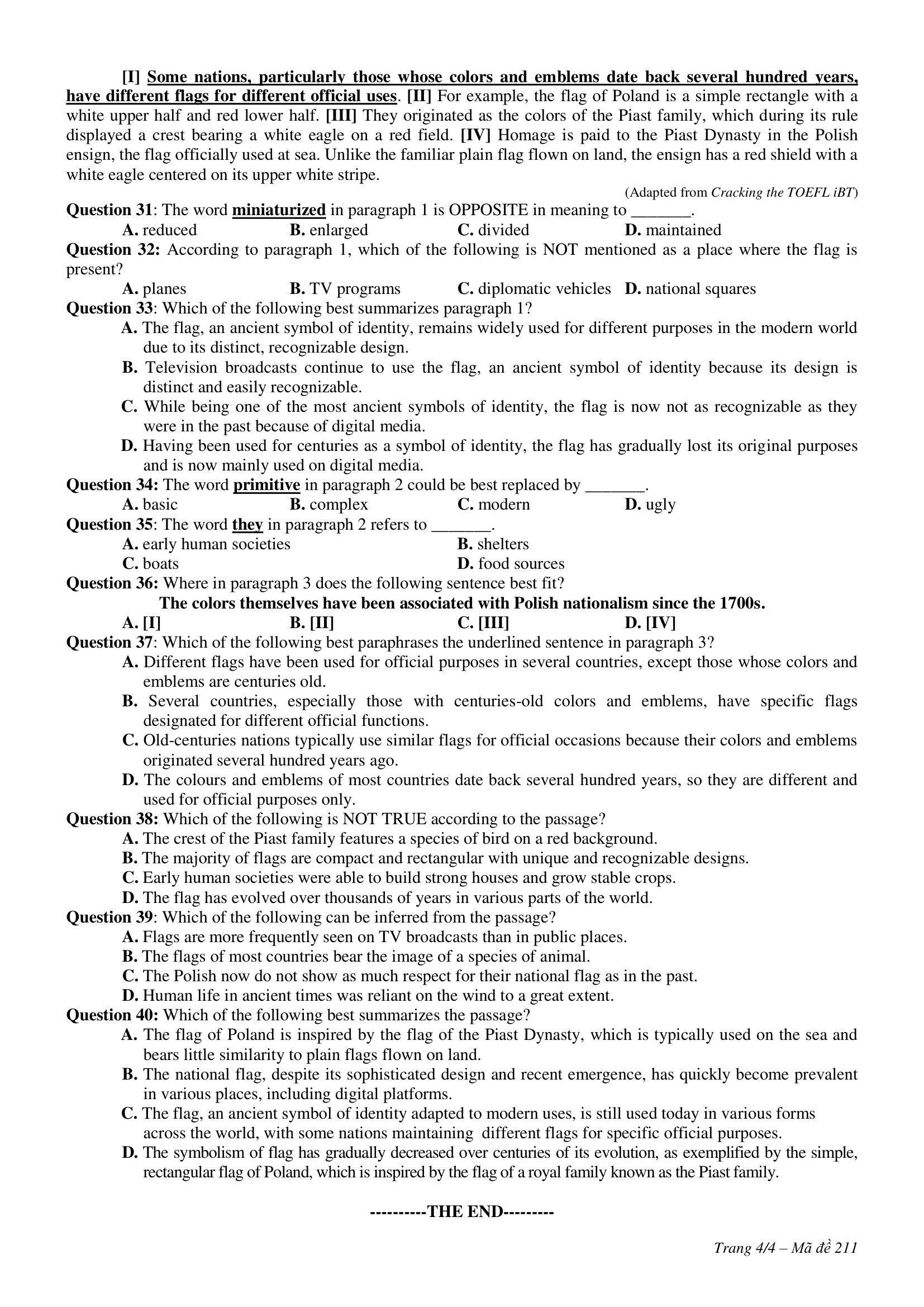
[I] Some nations, particularly those whose colors and emblems date back several hundred years, have different flags for different official uses. [II] For example, the flag of Poland is a simple rectangle with a white upper half and red lower half. [III] They originated as the colors of the Piast family, which during its rule displayed a crest bearing a white eagle on a red field. [IV] Homage is paid to the Piast Dynasty in the Polish ensign, the flag officially used at sea. Unlike the familiar plain flag flown on land, the ensign has a red shield with a white eagle centered on its upper white stripe.
(Adapted from Cracking the TOEFL iBT)
Câu 31: The word miniaturized in paragraph 1 is OPPOSITE in meaning to _____.
A. reduced
B. enlarged
C. divided
D. maintained
Câu 32: According to paragraph 1, which of the following is NOT mentioned as a place where the flag is present?
A. planes
B. TV programs
C. diplomatic vehicles
D. national squares
Câu 33: Which of the following best summarizes paragraph 1?
A. The flag, an ancient symbol of identity, remains widely used for different purposes in the modern world due to its distinct, recognizable design.
B. Television broadcasts continue to use the flag, an ancient symbol of identity because its design is distinct and easily recognizable.
C. While being one of the most ancient symbols of identity, the flag is now not as recognizable as they were in the past because of digital media.
D. Having been used for centuries as a symbol of identity, the flag has gradually lost its original purposes and is now mainly used on digital media.
Câu 34: The word primitive in paragraph 2 could be best replaced by _____.
A. basic
B. complex
C. modern
D. ugly
Câu 35: The word they in paragraph 2 refers to _____.
A. early human societies
B. shelters
C. boats
D. food sources
Câu 36: Where in paragraph 3 does the following sentence best fit?
The colors themselves have been associated with Polish nationalism since the 1700s.
A. [I]
B. [II]
C. [III]
D. [IV]
Câu 37: Which of the following best paraphrases the underlined sentence in paragraph 3?
A. Different flags have been used for official purposes in several countries, except those whose colors and emblems are centuries old.
B. Several countries, especially those with centuries-old colors and emblems, have specific flags designated for different official functions.
C. Old-centuries nations typically use similar flags for official occasions because their colors and emblems originated several hundred years ago.
D. The colours and emblems of most countries date back several hundred years, so they are different and used for official purposes only.
Câu 38: Which of the following is NOT TRUE according to the passage?
A. The crest of the Piast family features a species of bird on a red background.
B. The majority of flags are compact and rectangular with unique and recognizable designs.
C. Early human societies were able to build strong houses and grow stable crops.
D. The flag has evolved over thousands of years in various parts of the world.
Câu 39: Which of the following can be inferred from the passage?
A. Flags are more frequently seen on TV broadcasts than in public places.
B. The flags of most countries bear the image of a species of animal.
C. The Polish now do not show as much respect for their national flag as in the past.
D. Human life in ancient times was reliant on the wind to a great extent.
Câu 40: Which of the following best summarizes the passage?
A. The flag of Poland is inspired by the flag of the Piast Dynasty, which is typically used on the sea and bears little similarity to plain flags flown on land.
B. The national flag, despite its sophisticated design and recent emergence, has quickly become prevalent in various places, including digital platforms.
C. The flag, an ancient symbol of identity adapted to modern uses, is still used today in various forms across the world, with some nations maintaining different flags for specific official purposes.
D. The symbolism of flag has gradually decreased over centuries of its evolution, as exemplified by the simple, rectangular flag of Poland, which is inspired by the flag of a royal family known as the Piast family.
Mã đề 213
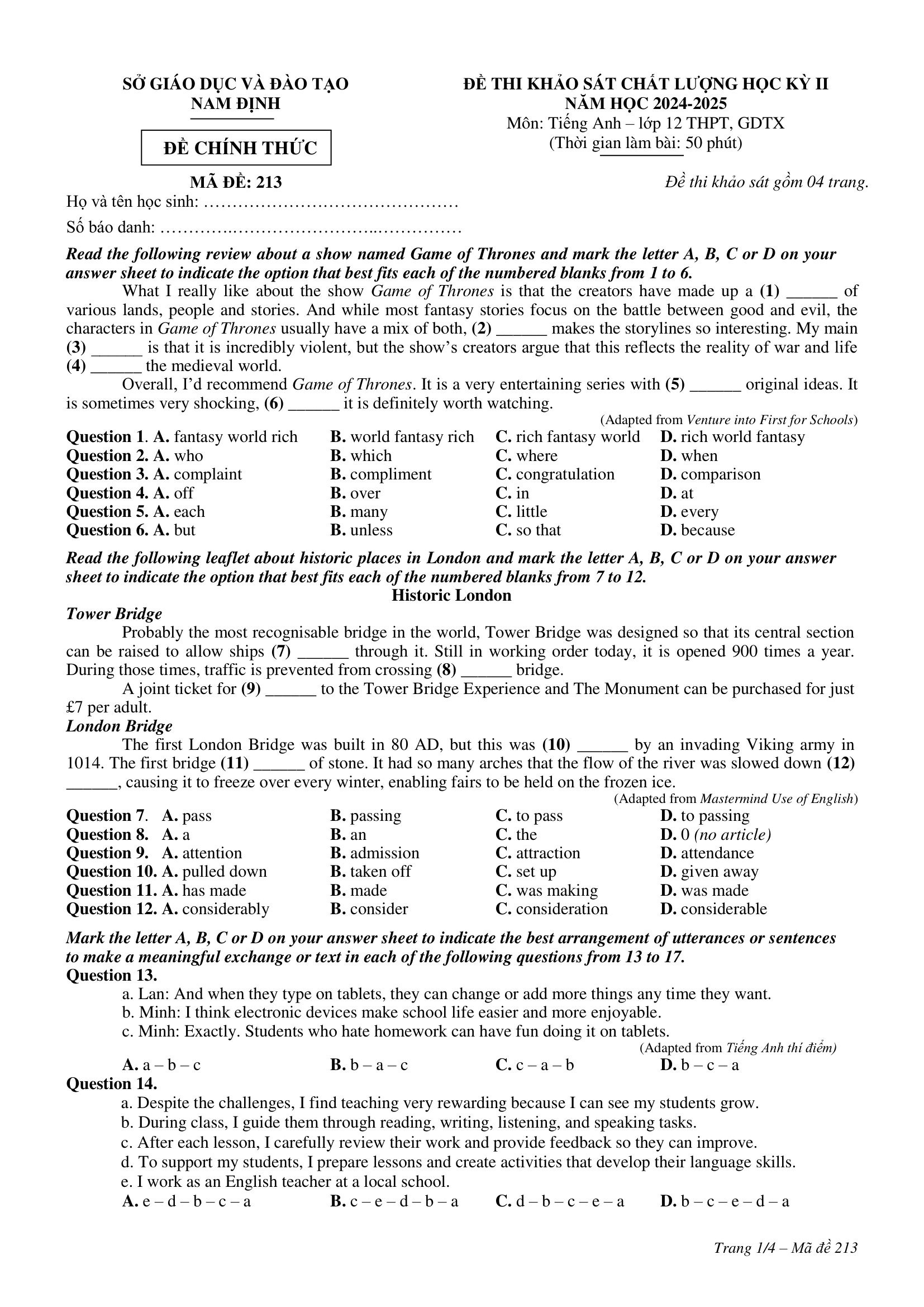
Read the following review about a show named Game of Thrones and mark the letter A, B, C or D on your answer sheet to indicate the option that best fits each of the numbered blanks from 1 to 6.
What I really like about the show Game of Thrones is that the creators have made up a (1) _____ of various lands, people and stories. And while most fantasy stories focus on the battle between good and evil, the characters in Game of Thrones usually have a mix of both, (2) _____ makes the storylines so interesting. My main (3) _____ is that it is incredibly violent, but the show’s creators argue that this reflects the reality of war and life (4) _____ the medieval world.
Overall, I’d recommend Game of Thrones. It is a very entertaining series with (5) _____ original ideas. It is sometimes very shocking, (6) _____ it is definitely worth watching.
(Adapted from Venture into First for Schools)
Câu 1:
A. fantasy world rich
B. world fantasy rich
C. rich fantasy world
D. rich world fantasy
Câu 2:
A. who
B. which
C. where
D. when
Câu 3:
A. complaint
B. compliment
C. congratulation
D. comparison
Câu 4:
A. off
B. over
C. in
D. at
Câu 5:
A. each
B. many
C. little
D. every
Câu 6:
A. but
B. unless
C. so that
D. because
Read the following leaflet about historic places in London and mark the letter A, B, C or D on your answer sheet to indicate the option that best fits each of the numbered blanks from 7 to 12.
Historic London
Tower Bridge
Probably the most recognisable bridge in the world, Tower Bridge was designed so that its central section can be raised to allow ships (7) _____ through it. Still in working order today, it is opened 900 times a year. During those times, traffic is prevented from crossing (8) _____ bridge.
A joint ticket for (9) _____ to the Tower Bridge Experience and The Monument can be purchased for just £7 per adult.
London Bridge
The first London Bridge was built in 80 AD, but this was (10) _____ by an invading Viking army in 1014. The first bridge (11) _____ of stone. It had so many arches that the flow of the river was slowed down (12) _____, causing it to freeze over every winter, enabling fairs to be held on the frozen ice.
(Adapted from Mastermind Use of English)
Câu 7:
A. pass
B. passing
C. to pass
D. to passing
Câu 8:
A. a
B. an
C. the
D. 0 (no article)
Câu 9:
A. attention
B. admission
C. attraction
D. attendance
Câu 10:
A. pulled down
B. taken off
C. set up
D. given away
Câu 11:
A. has made
B. made
C. was making
D. was made
Câu 12:
A. considerably
B. consider
C. consideration
D. considerable
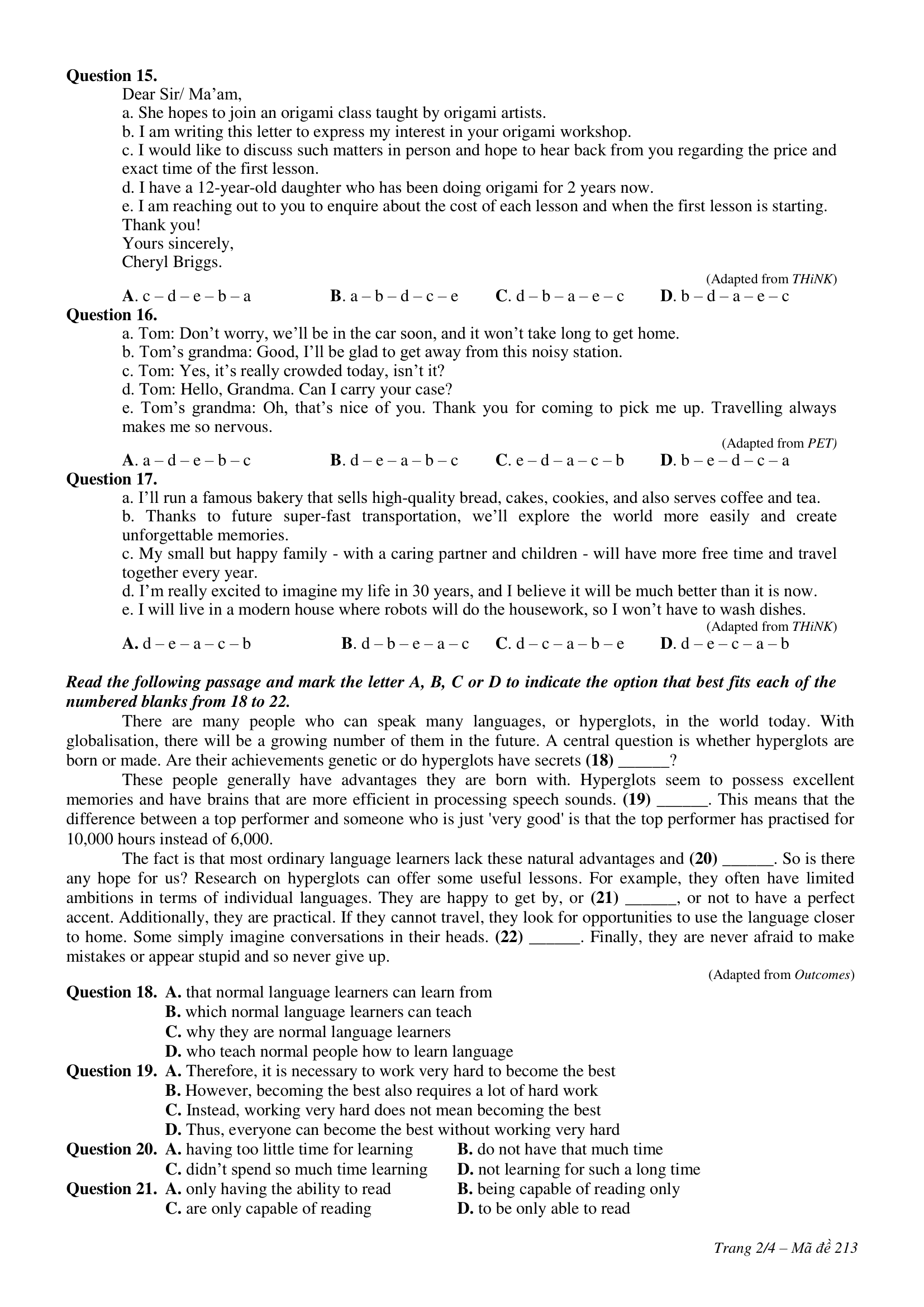
Câu 13: Mark the letter A, B, C or D on your answer sheet to indicate the best arrangement of utterances or sentences to make a meaningful exchange or text in each of the following questions from 13 to 17.
a. Lan: And when they type on tablets, they can change or add more things any time they want.
b. Minh: I think electronic devices make school life easier and more enjoyable.
c. Minh: Exactly. Students who hate homework can have fun doing it on tablets.
(Adapted from Tiếng Anh thí điểm)
A. a – b – c
B. b – a – c
C. c – a – b
D. b – c – a
Câu 14: a. Despite the challenges, I find teaching very rewarding because I can see my students grow.
b. During class, I guide them through reading, writing, listening, and speaking tasks.
c. After each lesson, I carefully review their work and provide feedback so they can improve.
d. To support my students, I prepare lessons and create activities that develop their language skills.
e. I work as an English teacher at a local school.
A. e – d – b – c – a
B. c – e – d – b – a
C. d – b – c – e – a
D. b – c – e – d – a
Câu 15: Dear Sir/ Ma’am,
a. She hopes to join an origami class taught by origami artists.
b. I am writing this letter to express my interest in your origami workshop.
c. I would like to discuss such matters in person and hope to hear back from you regarding the price and exact time of the first lesson.
d. I have a 12-year-old daughter who has been doing origami for 2 years now.
e. I am reaching out to you to enquire about the cost of each lesson and when the first lesson is starting.
Thank you!
Yours sincerely,
Cheryl Briggs.
(Adapted from THiNK)
A. c – d – e – b – a
B. a – b – d – c – e
C. d – b – a – e – c
D. b – d – a – e – c
Câu 16: a. Tom: Don’t worry, we’ll be in the car soon, and it won’t take long to get home.
b. Tom’s grandma: Good, I’ll be glad to get away from this noisy station.
c. Tom: Yes, it’s really crowded today, isn’t it?
d. Tom: Hello, Grandma. Can I carry your case?
e. Tom’s grandma: Oh, that’s nice of you. Thank you for coming to pick me up. Travelling always makes me so nervous.
(Adapted from PET)
A. a – d – e – b – c
B. d – e – a – b – c
C. e – d – a – c – b
D. b – e – d – c – a
Câu 17: a. I’ll run a famous bakery that sells high-quality bread, cakes, cookies, and also serves coffee and tea.
b. Thanks to future super-fast transportation, we’ll explore the world more easily and create unforgettable memories.
c. My small but happy family – with a caring partner and children – will have more free time and travel together every year.
d. I’m really excited to imagine my life in 30 years, and I believe it will be much better than it is now.
e. I will live in a modern house where robots will do the housework, so I won’t have to wash dishes.
(Adapted from THiNK)
A. d – e – a – c – b
B. d – b – e – a – c
C. d – c – a – b – e
D. d – e – c – a – b
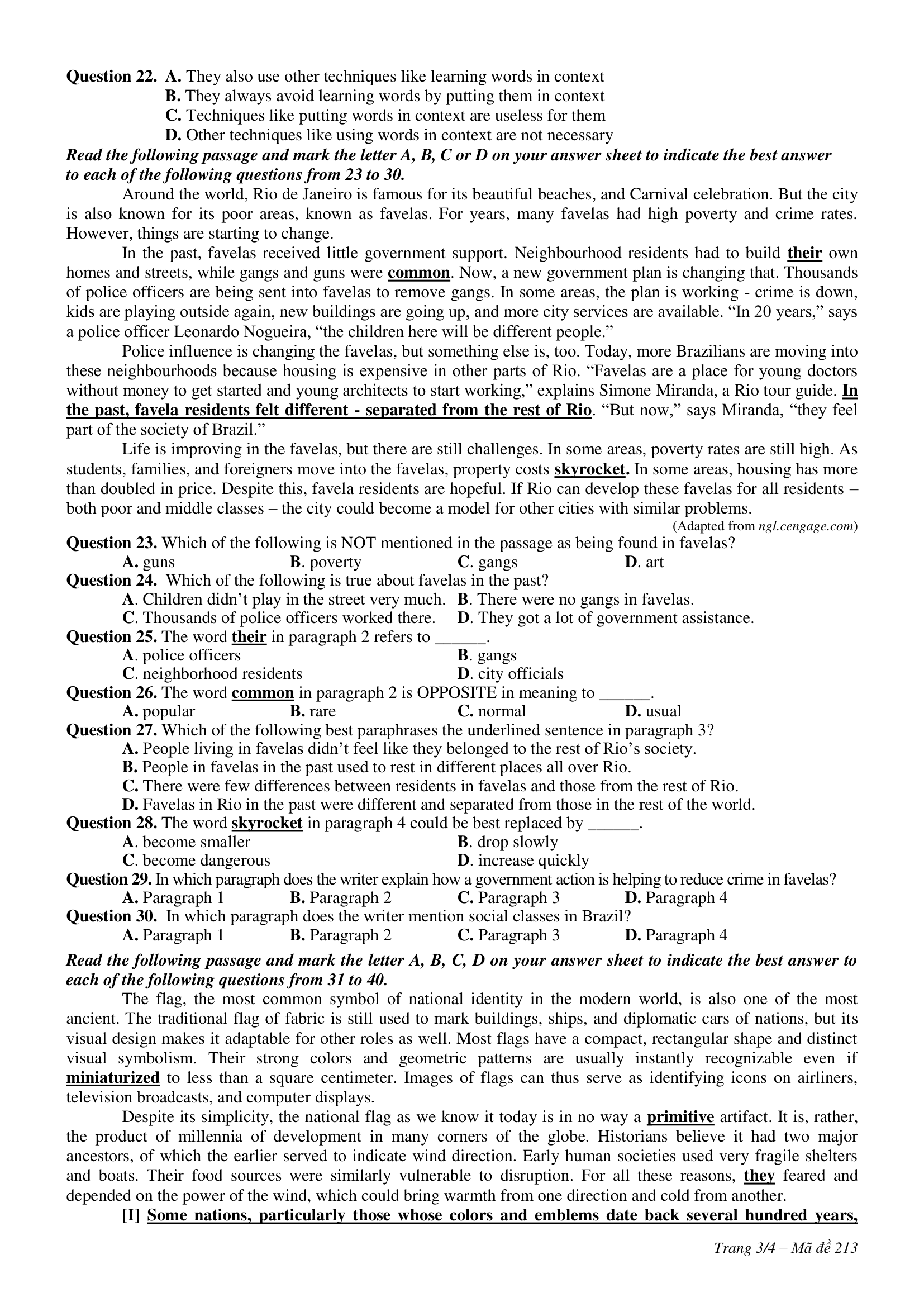
Read the following passage and mark the letter A, B, C or D to indicate the option that best fits each of the numbered blanks from 18 to 22.
There are many people who can speak many languages, or hyperglots, in the world today. With globalisation, there will be a growing number of them in the future. A central question is whether hyperglots are born or made. Are their achievements genetic or do hyperglots have secrets (18) _____?
These people generally have advantages they are born with. Hyperglots seem to possess excellent memories and have brains that are more efficient in processing speech sounds. (19) _____. This means that the difference between a top performer and someone who is just ‘very good’ is that the top performer has practised for 10,000 hours instead of 6,000.
The fact is that most ordinary language learners lack these natural advantages and (20) _____. So is there any hope for us? Research on hyperglots can offer some useful lessons. For example, they often have limited ambitions in terms of individual languages. They are happy to get by, or (21) _____, or not to have a perfect accent. Additionally, they are practical. If they cannot travel, they look for opportunities to use the language closer to home. Some simply imagine conversations in their heads. (22) _____. Finally, they are never afraid to make mistakes or appear stupid and so never give up.
(Adapted from Outcomes)
Câu 18:
A. that normal language learners can learn from
B. which normal language learners can teach
C. why they are normal language learners
D. who teach normal people how to learn language
Câu 19:
A. Therefore, it is necessary to work very hard to become the best
B. However, becoming the best also requires a lot of hard work
C. Instead, working very hard does not mean becoming the best
D. Thus, everyone can become the best without working very hard
Câu 20:
A. having too little time for learning
B. do not have that much time
C. didn’t spend so much time learning
D. not learning for such a long time
Câu 21:
A. only having the ability to read
B. being capable of reading only
C. are only capable of reading
D. to be only able to read
Câu 22:
A. They also use other techniques like learning words in context
B. They always avoid learning words by putting them in context
C. Techniques like putting words in context are useless for them
D. Other techniques like using words in context are not necessary
Read the following passage and mark the letter A, B, C or D on your answer sheet to indicate the best answer to each of the following questions from 23 to 30.
Around the world, Rio de Janeiro is famous for its beautiful beaches, and Carnival celebration. But the city is also known for its poor areas, known as favelas. For years, many favelas had high poverty and crime rates. However, things are starting to change.
In the past, favelas received little government support. Neighbourhood residents had to build their own homes and streets, while gangs and guns were common. Now, a new government plan is changing that. Thousands of police officers are being sent into favelas to remove gangs. In some areas, the plan is working – crime is down, kids are playing outside again, new buildings are going up, and more city services are available. “In 20 years,” says a police officer Leonardo Nogueira, “the children here will be different people.”
Police influence is changing the favelas, but something else is, too. Today, more Brazilians are moving into these neighbourhoods because housing is expensive in other parts of Rio. “Favelas are a place for young doctors without money to get started and young architects to start working,” explains Simone Miranda, a Rio tour guide. In the past, favela residents felt different – separated from the rest of Rio. “But now,” says Miranda, “they feel part of the society of Brazil.”
Life is improving in the favelas, but there are still challenges. In some areas, poverty rates are still high. As students, families, and foreigners move into the favelas, property costs skyrocket. In some areas, housing has more than doubled in price. Despite this, favela residents are hopeful. If Rio can develop these favelas for all residents – both poor and middle classes – the city could become a model for other cities with similar problems.
(Adapted from ngl.cengage.com)
Câu 23: Which of the following is NOT mentioned in the passage as being found in favelas?
A. guns
B. poverty
C. gangs
D. art
Câu 24: Which of the following is true about favelas in the past?
A. Children didn’t play in the street very much.
B. There were no gangs in favelas.
C. Thousands of police officers worked there.
D. They got a lot of government assistance.
Câu 25: The word their in paragraph 2 refers to _____.
A. police officers
B. gangs
C. neighborhood residents
D. city officials
Câu 26: The word common in paragraph 2 is OPPOSITE in meaning to _____.
A. popular
B. rare
C. normal
D. usual
Câu 27: Which of the following best paraphrases the underlined sentence in paragraph 3?
A. People living in favelas didn’t feel like they belonged to the rest of Rio’s society.
B. People in favelas in the past used to rest in different places all over Rio.
C. There were few differences between residents in favelas and those from the rest of Rio.
D. Favelas in Rio in the past were different and separated from those in the rest of the world.
Câu 28: The word skyrocket in paragraph 4 could be best replaced by _____.
A. become smaller
B. drop slowly
C. become dangerous
D. increase quickly
Câu 29: In which paragraph does the writer explain how a government action is helping to reduce crime in favelas?
A. Paragraph 1
B. Paragraph 2
C. Paragraph 3
D. Paragraph 4
Câu 30: In which paragraph does the writer mention social classes in Brazil?
A. Paragraph 1
B. Paragraph 2
C. Paragraph 3
D. Paragraph 4
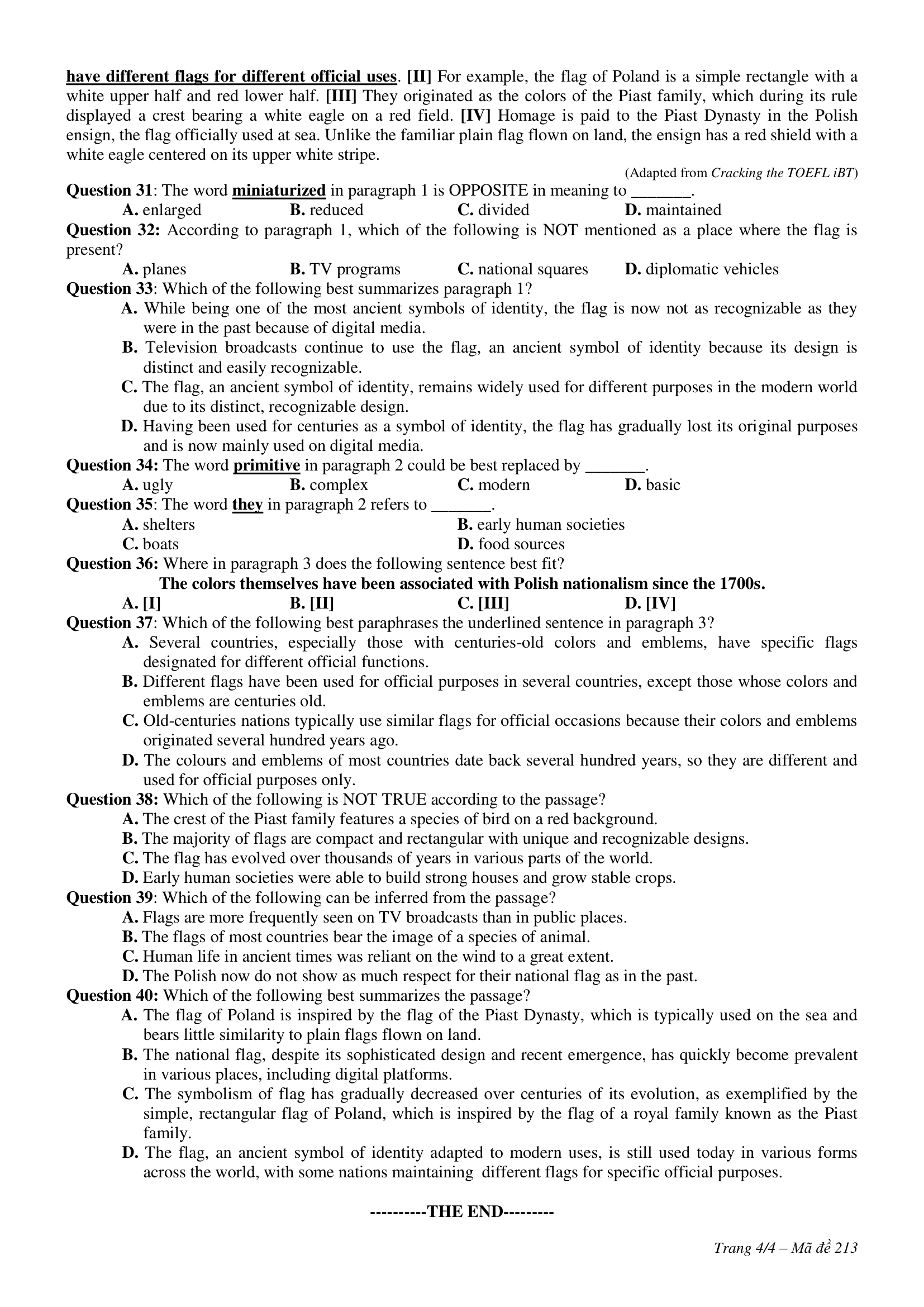
Read the following passage and mark the letter A, B, C, D on your answer sheet to indicate the best answer to each of the following questions from 31 to 40.
The flag, the most common symbol of national identity in the modern world, is also one of the most ancient. The traditional flag of fabric is still used to mark buildings, ships, and diplomatic cars of nations, but its visual design makes it adaptable for other roles as well. Most flags have a compact, rectangular shape and distinct visual symbolism. Their strong colors and geometric patterns are usually instantly recognizable even if miniaturized to less than a square centimeter. Images of flags can thus serve as identifying icons on airliners, television broadcasts, and computer displays.
Despite its simplicity, the national flag as we know it today is in no way a primitive artifact. It is, rather, the product of millennia of development in many corners of the globe. Historians believe it had two major ancestors, of which the earlier served to indicate wind direction. Early human societies used very fragile shelters and boats. Their food sources were similarly vulnerable to disruption. For all these reasons, they feared and depended on the power of the wind, which could bring warmth from one direction and cold from another.
[I] Some nations, particularly those whose colors and emblems date back several hundred years, have different flags for different official uses. [II] For example, the flag of Poland is a simple rectangle with a white upper half and red lower half. [III] They originated as the colors of the Piast family, which during its rule displayed a crest bearing a white eagle on a red field. [IV] Homage is paid to the Piast Dynasty in the Polish ensign, the flag officially used at sea. Unlike the familiar plain flag flown on land, the ensign has a red shield with a white eagle centered on its upper white stripe.
(Adapted from Cracking the TOEFL iBT)
Câu 31: The word miniaturized in paragraph 1 is OPPOSITE in meaning to _____.
A. enlarged
B. reduced
C. divided
D. maintained
Câu 32: According to paragraph 1, which of the following is NOT mentioned as a place where the flag is present?
A. planes
B. TV programs
C. national squares
D. diplomatic vehicles
Câu 33: Which of the following best summarizes paragraph 1?
A. While being one of the most ancient symbols of identity, the flag is now not as recognizable as they were in the past because of digital media.
B. Television broadcasts continue to use the flag, an ancient symbol of identity because its design is distinct and easily recognizable.
C. The flag, an ancient symbol of identity, remains widely used for different purposes in the modern world due to its distinct, recognizable design.
D. Having been used for centuries as a symbol of identity, the flag has gradually lost its original purposes and is now mainly used on digital media.
Câu 34: The word primitive in paragraph 2 could be best replaced by _____.
A. ugly
B. complex
C. modern
D. basic
Câu 35: The word they in paragraph 2 refers to _____.
A. shelters
B. early human societies
C. boats
D. food sources
Câu 36: Where in paragraph 3 does the following sentence best fit?
The colors themselves have been associated with Polish nationalism since the 1700s.
A. [I]
B. [II]
C. [III]
D. [IV]
Câu 37: Which of the following best paraphrases the underlined sentence in paragraph 3?
A. Several countries, especially those with centuries-old colors and emblems, have specific flags designated for different official functions.
B. Different flags have been used for official purposes in several countries, except those whose colors and emblems are centuries old.
C. Old-centuries nations typically use similar flags for official occasions because their colors and emblems originated several hundred years ago.
D. The colours and emblems of most countries date back several hundred years, so they are different and used for official purposes only.
Câu 38: Which of the following is NOT TRUE according to the passage?
A. The crest of the Piast family features a species of bird on a red background.
B. The majority of flags are compact and rectangular with unique and recognizable designs.
C. The flag has evolved over thousands of years in various parts of the world.
D. Early human societies were able to build strong houses and grow stable crops.
Câu 39: Which of the following can be inferred from the passage?
A. Flags are more frequently seen on TV broadcasts than in public places.
B. The flags of most countries bear the image of a species of animal.
C. Human life in ancient times was reliant on the wind to a great extent.
D. The Polish now do not show as much respect for their national flag as in the past.
Câu 40: Which of the following best summarizes the passage?
A. The flag of Poland is inspired by the flag of the Piast Dynasty, which is typically used on the sea and bears little similarity to plain flags flown on land.
B. The national flag, despite its sophisticated design and recent emergence, has quickly become prevalent in various places, including digital platforms.
C. The symbolism of flag has gradually decreased over centuries of its evolution, as exemplified by the simple, rectangular flag of Poland, which is inspired by the flag of a royal family known as the Piast family.
D. The flag, an ancient symbol of identity adapted to modern uses, is still used today in various forms across the world, with some nations maintaining different flags for specific official purposes.