
Đề thi thử Tiếng Anh THPT 2026 – Sở GD&ĐT Quảng Ninh, THPT Cẩm Phả là đề ôn tập môn Tiếng Anh dành cho học sinh lớp 12, bám sát nội dung SGK Cánh Diều. Đề thi do ThS. Phạm Quốc Toản – giáo viên trường THPT Nguyễn Tất Thành, Hà Nội biên soạn năm 2026, với các câu hỏi được thiết kế từ mức độ nhận biết đến vận dụng cao, giúp các em làm quen với cấu trúc và độ khó của đề thi thật. Đây là tài liệu luyện tập không thể thiếu để chuẩn bị cho kỳ Thi thử THPT Quốc Gia sắp tới, được cung cấp độc quyền tại detracnghiem.edu.vn.
Để đạt kết quả cao trong các kỳ thi thử Tiếng Anh THPT, đặc biệt là dành cho học sinh lớp 12, đề thi này được xây dựng kỹ lưỡng với hệ thống câu hỏi đa dạng, kèm theo lời giải thích rõ ràng và chi tiết. Điều này không chỉ giúp các em biết đáp án mà còn hiểu sâu sắc kiến thức, rèn luyện kỹ năng làm bài hiệu quả. Hãy cùng detracnghiem.edu.vn luyện tập ngay hôm nay để nâng cao năng lực và tự tin bước vào kỳ thi chính thức.
Đề thi thử Tiếng Anh THPT 2026 – Sở GD&ĐT Quảng Ninh, THPT Cẩm Phả
LINK PDF ĐỀ THI [gồm ĐỀ THI, ĐÁP ÁN, LỜI GIẢI]:
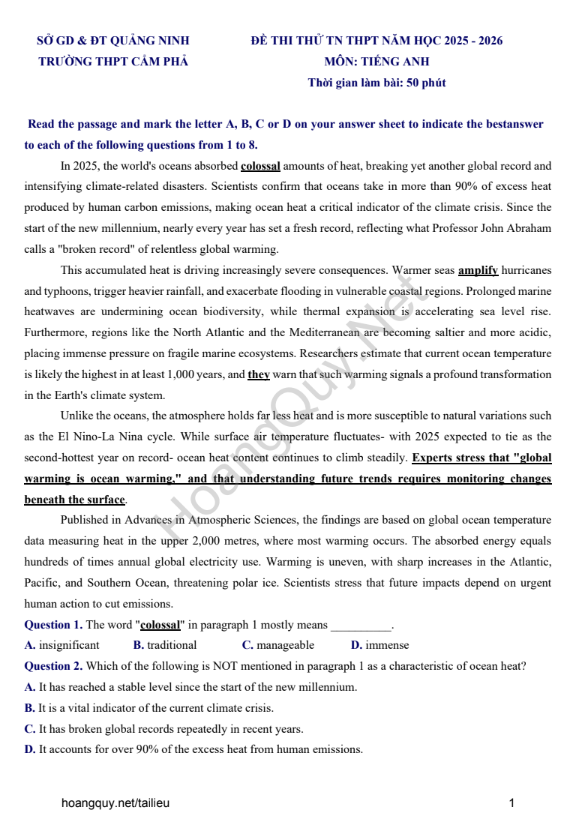
Read the passage and mark the letter A, B, C or D on your answer sheet to indicate the best answer
to each of the following questions from 1 to 8.
In 2025, the world’s oceans absorbed colossal amounts of heat, breaking yet another global record and
intensifying climate-related disasters. Scientists confirm that oceans take in more than 90% of excess heat
produced by human carbon emissions, making ocean heat a critical indicator of the climate crisis. Since the
start of the new millennium, nearly every year has set a fresh record, reflecting what Professor John Abraham
calls a “broken record” of relentless global warming.
This accumulated heat is driving increasingly severe consequences. Warmer seas amplify hurricanes
and typhoons, trigger heavier rainfall, and exacerbate flooding in vulnerable coastal regions. Prolonged marine
heatwaves are undermining ocean biodiversity, while thermal expansion is accelerating sea level rise.
Furthermore, regions like the North Atlantic and the Mediterranean are becoming saltier and more acidic,
placing immense pressure on fragile marine ecosystems. Researchers estimate that current ocean temperature
is likely the highest in at least 1,000 years, and they warn that such warming signals a profound transformation
in the Earth’s climate system.
Unlike the oceans, the atmosphere holds far less heat and is more susceptible to natural variations such
as the El Nino-La Nina cycle. While surface air temperature fluctuates- with 2025 expected to tie as the
second-hottest year on record- ocean heat content continues to climb steadily. Experts stress that “global
warming is ocean warming,” and that understanding future trends requires monitoring changes
beneath the surface.
Published in Advances in Atmospheric Sciences, the findings are based on global ocean temperature
data measuring heat in the upper 2,000 metres, where most warming occurs. The absorbed energy equals
hundreds of times annual global electricity use. Warming is uneven, with sharp increases in the Atlantic,
Pacific, and Southern Ocean, threatening polar ice. Scientists stress that future impacts depend on urgent
human action to cut emissions.
Question 1. The word colossal in paragraph 1 mostly means _________.
A. insignificant
B. traditional
C. manageable
D. immense
Question 2. Which of the following is NOT mentioned in paragraph 1 as a characteristic of ocean heat?
A. It has reached a stable level since the start of the new millennium.
B. It is a vital indicator of the current climate crisis.
C. It has broken global records repeatedly in recent years.
D. It accounts for over 90% of the excess heat from human emissions.
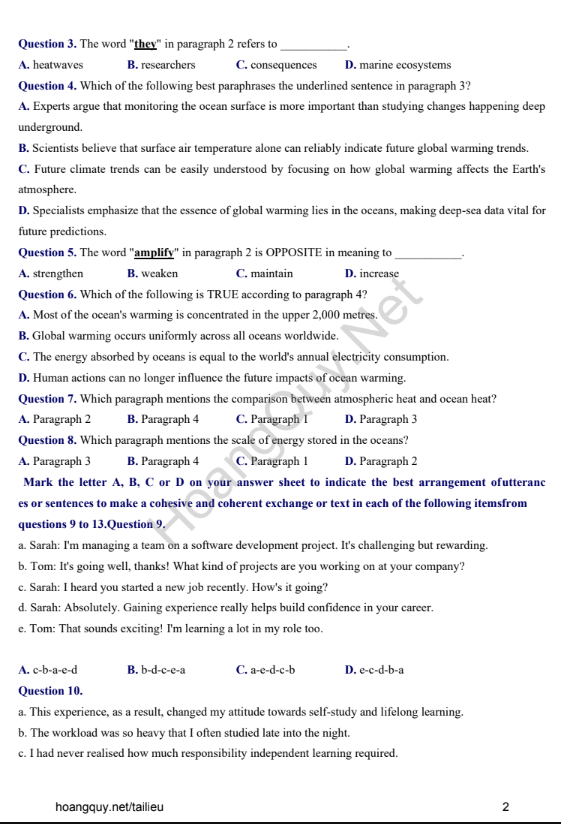
Question 3. The word they in paragraph 2 refers to _________.
A. heatwaves
B. researchers
C. consequences
D. marine ecosystems
Question 4. Which of the following best paraphrases the underlined sentence in paragraph 3?
A. Experts argue that monitoring the ocean surface is more important than studying changes happening deep
underground.
B. Scientists believe that surface air temperature alone can reliably indicate future global warming trends.
C. Future climate trends can be easily understood by focusing on how global warming affects the Earth’s
atmosphere.
D. Specialists emphasize that the essence of global warming lies in the oceans, making deep-sea data vital for
future predictions.
Question 5. The word “amplify” in paragraph 2 is OPPOSITE in meaning to _________.
A. strengthen
B. weaken
C. maintain
D. increase
Question 6. Which of the following is TRUE according to paragraph 4?
A. Most of the ocean’s warming is concentrated in the upper 2,000 metres.
B. Global warming occurs uniformly across all oceans worldwide.
C. The energy absorbed by oceans is equal to the world’s annual electricity consumption.
D. Human actions can no longer influence the future impacts of ocean warming.
Question 7. Which paragraph mentions the comparison between atmospheric heat and ocean heat?
A. Paragraph 2
B. Paragraph 4
C. Paragraph 1
D. Paragraph 3
Question 8. Which paragraph mentions the scale of energy stored in the oceans?
A. Paragraph 3
B. Paragraph 4
C. Paragraph 1
D. Paragraph 2
Mark the letter A, B, C or D on your answer sheet to indicate the best arrangement of utterances or sentences to make a cohesive and coherent exchange or text in each of the following items from questions 9 to 13.
Question 9.
a. Sarah: I’m managing a team on a software development project. It’s challenging but rewarding.
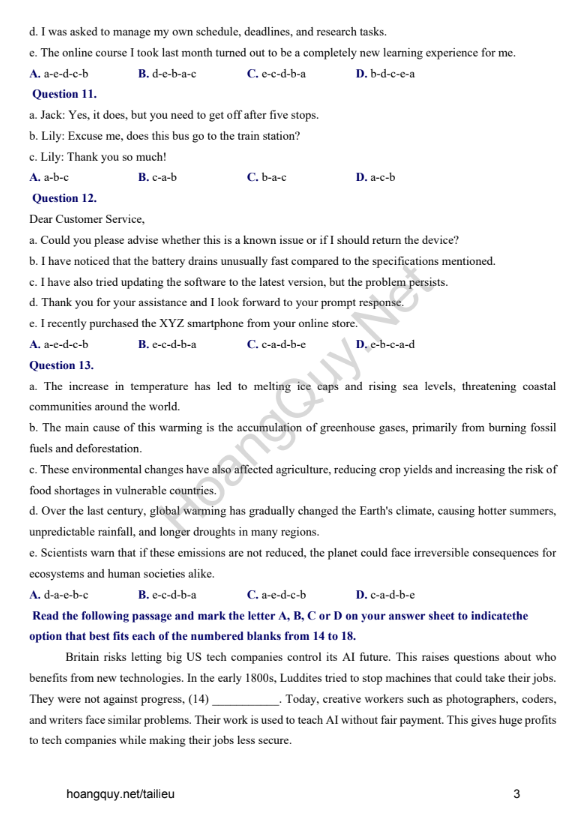
b. Tom: It’s going well, thanks! What kind of projects are you working on at your company?
c. Sarah: I heard you started a new job recently. How’s it going?
d. Sarah: Absolutely. Gaining experience really helps build confidence in your career.
e. Tom: That sounds exciting! I’m learning a lot in my role too.
A. c-b-a-e-d
B. b-d-e-c-a
C. a-c-d-c-b
D. e-c-d-b-a
Question 10.
a. This experience, as a result, changed my attitude towards self-study and lifelong learning.
b. The workload was so heavy that I often studied late into the night.
c. I had never realised how much responsibility independent learning required.
d. I was asked to manage my own schedule, deadlines, and research tasks.
e. The online course I took last month turned out to be a completely new learning experience for me.
A. a-e-d-c-b
B. d-e-b-a-c
C. e-c-d-b-a
D. b-d-c-e-a
Question 11.
a. Jack: Yes, it does, but you need to get off after five stops.
b. Lily: Excuse me, does this bus go to the train station?
c. Lily: Thank you so much!
A. a-b-c
B. c-a-b
C. b-a-c
D. a-c-b
Question 12.
a. Dear Customer Service,
b. Could you please advise whether this is a known issue or if I should return the device?
c. I have noticed that the battery drains unusually fast compared to the specifications mentioned.
d. I have also tried updating the software to the latest version, but the problem persists.
e. Thank you for your assistance and I look forward to your prompt response.
f. I recently purchased the XYZ smartphone from your online store.
A. a-e-d-c-b
B. e-c-d-b-a
C. c-a-d-b-e
D. a-f-c-d-b-e
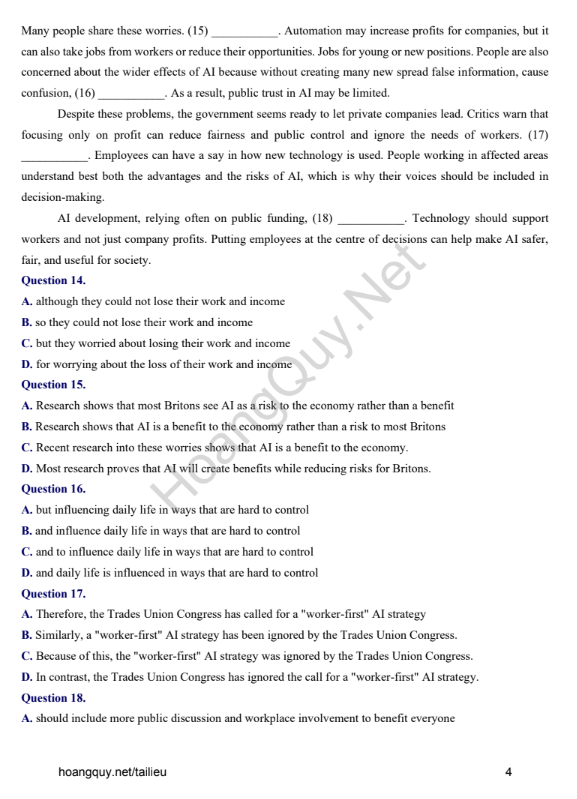
Question 13.
a. The increase in temperature has led to melting ice caps and rising sea levels, threatening coastal
communities around the world.
b. The main cause of this warming is the accumulation of greenhouse gases, primarily from burning fossil
fuels and deforestation.
c. These environmental changes have also affected agriculture, reducing crop yields and increasing the risk of
food shortages in vulnerable countries.
d. Over the last century, global warming has gradually changed the Earth’s climate, causing hotter summers,
unpredictable rainfall, and longer droughts in many regions.
e. Scientists warn that if these emissions are not reduced, the planet could face irreversible consequences for
ecosystems and human societies alike.
A. d-a-c-b-e
B. e-c-d-b-a
C. a-e-d-c-b
D. d-a-c-b-e
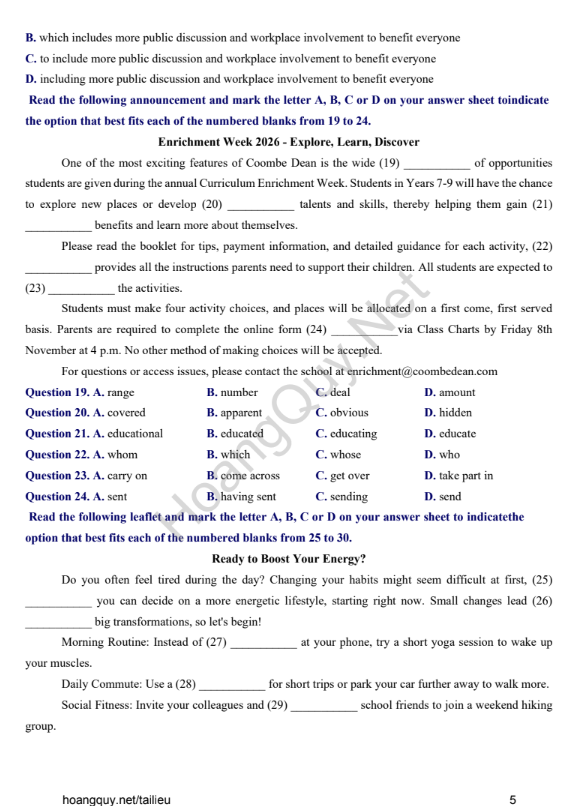
Read the following passage and mark the letter A, B, C or D on your answer sheet to indicate the
option that best fits each of the numbered blanks from 14 to 18.
Britain risks letting big US tech companies control its AI future. This raises questions about who
benefits from new technologies. In the early 1800s, Luddites tried to stop machines that could take their jobs.
They were not against progress, (14) __________. Today, creative workers such as photographers, coders,
and writers face similar problems. Their work is used to teach AI without fair payment. This gives huge profits
to tech companies while making their jobs less secure.
Many people share these worries. (15) __________ Automation may increase profits for companies, but it
can also take jobs from workers or reduce their opportunities. Jobs for young or new positions. People are also
concerned about the wider effects of AI because without creating many new spread false information, cause
confusion, (16) __________. As a result, public trust in AI may be limited.
Despite these problems, the government seems ready to let private companies lead. Critics warn that
focusing only on profit can reduce fairness and public control and ignore the needs of workers. (17)
__________. Employees can have a say in how new technology is used. People working in affected areas
understand best both the advantages and the risks of AI, which is why their voices should be included in
decision-making.
AI development, relying often on public funding, (18) __________. Technology should support
workers and not just company profits. Putting employees at the centre of decisions can help make AI safer,
fair, and useful for society.
Question 14.
A. although they could not lose their work and income
B. so they could not lose their work and income
C. but they worried about losing their work and income
D. for worrying about the loss of their work and income
Question 15.
A. Research shows that most Britons see AI as a risk to the economy rather than a benefit
B. Research shows that AI is a benefit to the economy rather than a risk to most Britons
C. Recent research into these worries shows that AI is a benefit to the economy.
D. Most research proves that AI will create benefits while reducing risks for Britons.
Question 16.
A. but influencing daily life in ways that are hard to control
B. and influence daily life in ways that are hard to control
C. and to influence daily life in ways that are hard to control
D. and daily life is influenced in ways that are hard to control
Question 17.
A. Therefore, the Trades Union Congress has called for a “worker-first” AI strategy
B. Similarly, a “worker-first” AI strategy has been ignored by the Trades Union Congress.
C. Because of this, the “worker-first” AI strategy was ignored by the Trades Union Congress.
D. In contrast, the Trades Union Congress has ignored the call for a “worker-first” AI strategy.
Question 18.
A. should include more public discussion and workplace involvement to benefit everyone
B. which includes more public discussion and workplace involvement to benefit everyone
C. to include more public discussion and workplace involvement to benefit everyone
D. including more public discussion and workplace involvement to benefit everyone
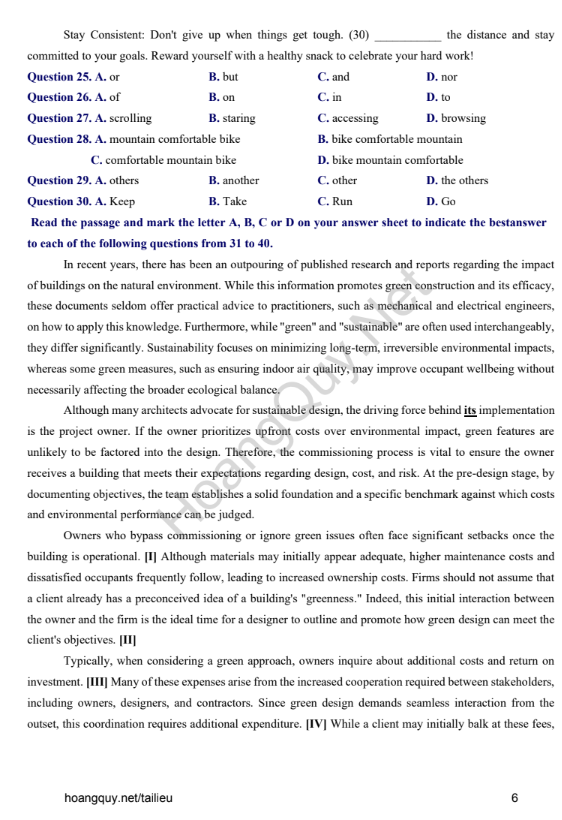
Read the following announcement and mark the letter A, B, C or D on your answer sheet to indicate the
option that best fits each of the numbered blanks from 19 to 24.
Enrichment Week 2026 – Explore, Learn, Discover
One of the most exciting features of Coombe Dean is the wide (19) __________ of opportunities
students are given during the annual Curriculum Enrichment Week. Students in Years 7-9 will have the chance
to explore new places or develop (20) __________ talents and skills, thereby helping them gain (21)
__________ benefits and learn more about themselves.
Please read the booklet for tips, payment information, and detailed guidance for each activity, (22)
__________ provides all the instructions parents need to support their children. All students are expected to
(23) __________ the activities.
Students must make four activity choices, and places will be allocated on a first come, first served
basis. Parents are required to complete the online form (24) __________ via Class Charts by Friday 8th
November at 4 p.m. No other method of making choices will be accepted.
For questions or access issues, please contact the school at enrichment@coombedean.com
Question 19.
A. range
B. number
C. deal
D. amount
Question 20.
A. covered
B. apparent
C. obvious
D. hidden
Question 21.
A. educational
B. educated
C. educating
D. educate
Question 22.
A. whom
B. which
C. whose
D. who
Question 23.
A. carry on
B. come across
C. get over
D. take part in
Question 24.
A. sent
B. having sent
C. sending
D. send
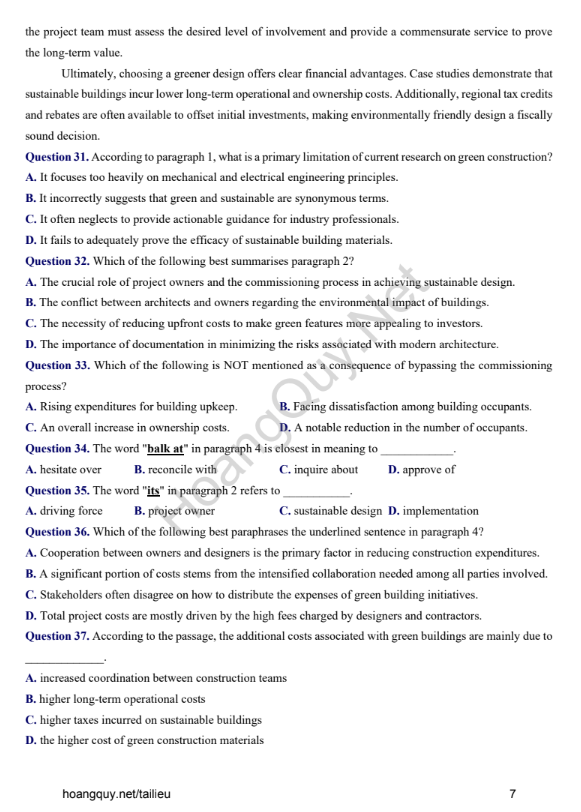
Read the following leaflet and mark the letter A, B, C or D on your answer sheet to indicate the
option that best fits each of the numbered blanks from 25 to 30.
Ready to Boost Your Energy?
Do you often feel tired during the day? Changing your habits might seem difficult at first, (25)
__________ you can decide on a more energetic lifestyle, starting right now. Small changes lead (26)
__________ big transformations, so let’s begin!
Morning Routine: Instead of (27) __________ at your phone, try a short yoga session to wake up
your muscles.
Daily Commute: Use a (28) __________ for short trips or park your car further away to walk more.
Social Fitness: Invite your colleagues and (29) __________ school friends to join a weekend hiking
group.
Stay Consistent: Don’t give up when things get tough. (30) __________ the distance and stay
committed to your goals. Reward yourself with a healthy snack to celebrate your hard work!
Question 25.
A. or
B. but
C. and
D. nor
Question 26.
A. of
B. on
C. in
D. to
Question 27.
A. scrolling
B. staring
C. accessing
D. browsing
Question 28.
A. mountain comfortable bike
B. bike comfortable mountain
C. comfortable mountain bike
D. bike mountain comfortable
Question 29.
A. others
B. another
C. other
D. the others
Question 30.
A. Keep
B. Take
C. Run
D. Go
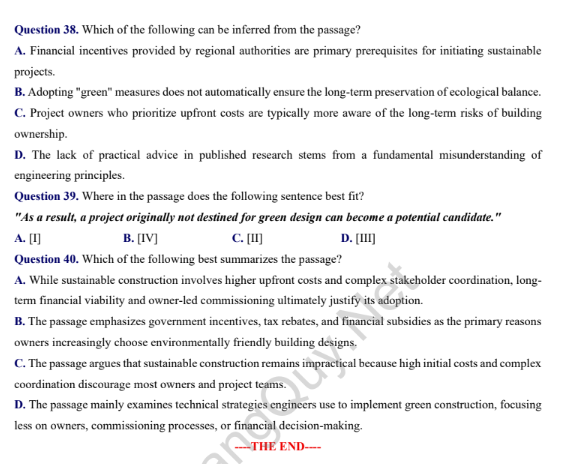
Read the passage and mark the letter A, B, C or D on your answer sheet to indicate the best answer
to each of the following questions from 31 to 40.
In recent years, there has been an outpouring of published research and reports regarding the impact
of buildings on the natural environment. While this information promotes green construction and its efficacy,
these documents seldom offer practical advice to practitioners, such as mechanical and electrical engineers,
on how to apply this knowledge. Furthermore, while “green” and “sustainable” are often used interchangeably,
they differ significantly. Sustainability focuses on minimizing long-term, irreversible environmental impacts,
whereas some green measures, such as ensuring indoor air quality, may improve occupant wellbeing without
necessarily affecting the broader ecological balance.
Although many architects advocate for sustainable design, the driving force behind its implementation
is the project owner. If the owner prioritizes upfront costs over environmental impact, green features are
unlikely to be factored into the design. Therefore, the commissioning process is vital to ensure the owner
receives a building that meets their expectations regarding design, cost, and risk. At the pre-design stage, by
documenting objectives, the team establishes a solid foundation and a specific benchmark against which costs
and environmental performance can be judged.
Owners who bypass commissioning or ignore green issues often face significant setbacks once the
building is operational. [I] Although materials may initially appear adequate, higher maintenance costs and
dissatisfied occupants frequently follow, leading to increased ownership costs. Firms should not assume that
a client already has a preconceived idea of a building’s “greenness.” Indeed, this initial interaction between
the owner and the firm is the ideal time for a designer to outline and promote how green design can meet the
client’s objectives. [II]
Typically, when considering a green approach, owners inquire about additional costs and return on
investment. [III] Many of these expenses arise from the increased cooperation required between stakeholders,
including owners, designers, and contractors. Since green design demands seamless interaction from the
outset, this coordination requires additional expenditure. [IV] While a client may initially balk at these fees,
the project team must assess the desired level of involvement and provide a commensurate service to prove
the long-term value.
Ultimately, choosing a greener design offers clear financial advantages. Case studies demonstrate that
sustainable buildings incur lower long-term operational and ownership costs. Additionally, regional tax credits
and rebates are often available to offset initial investments, making environmentally friendly design a fiscally
sound decision.
Question 31. According to paragraph 1, what is a primary limitation of current research on green construction?
A. It focuses too heavily on mechanical and electrical engineering principles.
B. It incorrectly suggests that green and sustainable are synonymous terms.
C. It often neglects to provide actionable guidance for industry professionals.
D. It fails to adequately prove the efficacy of sustainable building materials.
Question 32. Which of the following best summarises paragraph 2?
A. The crucial role of project owners and the commissioning process in achieving sustainable design.
B. The conflict between architects and owners regarding the environmental impact of buildings.
C. The necessity of reducing upfront costs to make green features more appealing to investors.
D. The importance of documentation in minimizing the risks associated with modern architecture.
Question 33. Which of the following is NOT mentioned as a consequence of bypassing the commissioning
process?
A. Rising expenditures for building upkeep.
B. Facing dissatisfaction among building occupants.
C. An overall increase in ownership costs.
D. A notable reduction in the number of occupants.
Question 34. The word “balk at” in paragraph 4 is closest in meaning to _________.
A. hesitate over
B. reconcile with
C. inquire about
D. approve of
Question 35. The word “its” in paragraph 2 refers to _________.
A. driving force
B. project owner
C. sustainable design
D. implementation
Question 36. Which of the following best paraphrases the underlined sentence in paragraph 4?
A. Cooperation between owners and designers is the primary factor in reducing construction expenditures.
B. A significant portion of costs stems from the intensified collaboration needed among all parties involved.
C. Stakeholders often disagree on how to distribute the expenses of green building initiatives.
D. Total project costs are mostly driven by the high fees charged by designers and contractors.
Question 37. According to the passage, the additional costs associated with green buildings are mainly due to
_________.
A. increased coordination between construction teams
B. higher long-term operational costs
C. higher taxes incurred on sustainable buildings
D. the higher cost of green construction materials
Question 38. Which of the following can be inferred from the passage?
A. Financial incentives provided by regional authorities are primary prerequisites for initiating sustainable
projects.
B. Adopting “green” measures does not automatically ensure the long-term preservation of ecological balance.
C. Project owners who prioritize upfront costs are typically more aware of the long-term risks of building
ownership.
D. The lack of practical advice in published research stems from a fundamental misunderstanding of
engineering principles.
Question 39. Where in the passage does the following sentence best fit?
“As a result, a project originally not destined for green design can become a potential candidate.”
A. [I]
B. [IV]
C. [III]
D. [II]
Question 40. Which of the following best summarizes the passage?
A. While sustainable construction involves higher upfront costs and complex stakeholder coordination, long-
term financial viability and owner-led commissioning ultimately justify its adoption.
B. The passage emphasizes government incentives, tax rebates, and financial subsidies as the primary reasons
owners increasingly choose environmentally friendly building designs.
C. The passage argues that sustainable construction remains impractical because high initial costs and complex
coordination discourage most owners and project teams.
D. The passage mainly examines technical strategies engineers use to implement green construction, focusing
less on owners, commissioning processes, or financial decision-making.
—THE END—